

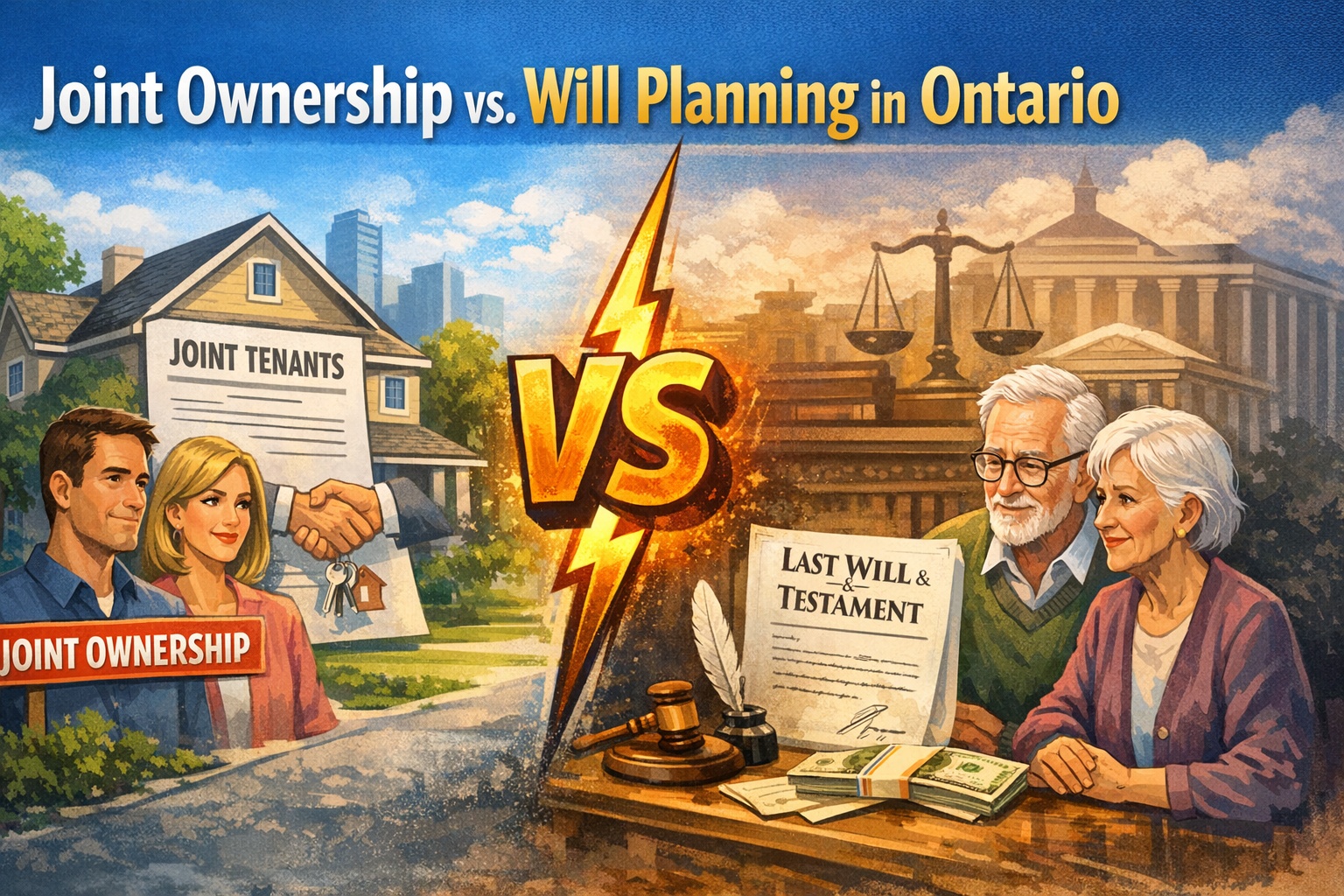
🏠 Joint Ownership vs. Will Planning in Ontario: Which Is Better?
📘 Introduction
When planning your estate in Ontario, one of the most common questions people ask is:
“Should I put my house or assets in joint ownership — or rely on my will?”
At first glance, joint ownership seems simple. It appears to avoid probate, reduce legal fees, and allow assets to transfer automatically after death. But is it really that straightforward?
In reality, deciding between joint ownership vs will Ontario estate planning strategies requires careful legal and financial consideration. While joint ownership can be beneficial in some cases, it also carries serious risks — especially when used improperly.
This comprehensive guide explains the advantages, disadvantages, tax implications, and legal consequences of both approaches — so you can make an informed decision that protects your family and your legacy.

⚖️ What Is Joint Ownership in Ontario?
Joint ownership occurs when two or more people legally own an asset together. In estate planning, the most common type is joint tenancy with right of survivorship.
When one joint owner dies:
- The surviving owner automatically inherits the deceased’s share.
- The asset bypasses probate.
- The transfer happens outside the will.
Joint ownership is commonly used for:
- Family homes
- Bank accounts
- Investment accounts
- Cottage properties
Because it avoids probate, many Ontarians assume it is the “best” estate planning tool. But comparing joint ownership vs will Ontario requires understanding what you may be giving up in exchange for convenience.
🧾 What Is Will Planning?
Will planning involves drafting a legally valid will that outlines:
- Who receives your property
- Who acts as executor
- Guardianship for minor children
- Instructions for digital assets
- Distribution timelines
When someone passes away with a will:
- The executor applies for probate.
- The court confirms the will’s validity.
- Assets are distributed according to the will’s instructions.
Although probate involves an Estate Administration Tax, wills provide clarity, flexibility, and protection that joint ownership sometimes lacks.
💰 Probate and Estate Administration Tax in Ontario
A major reason people consider joint ownership is to avoid probate fees.
In Ontario, the Estate Administration Tax is:
- $0 on the first $50,000
- $15 per $1,000 over $50,000
For example:
An estate worth $500,000 would pay approximately $6,750 in probate fees.
This often leads people to compare joint ownership vs will Ontario based purely on tax savings. But focusing only on probate costs can lead to unintended legal and financial consequences.
✅ Advantages of Joint Ownership
There are legitimate benefits to joint ownership in certain situations.
1️⃣ Avoids Probate
Assets held in joint tenancy pass directly to the surviving owner without court involvement.
2️⃣ Immediate Access
The surviving owner can access bank funds or sell property immediately without waiting months for probate approval.
3️⃣ Simplicity for Spouses
For married couples, joint ownership is often appropriate for:
- Matrimonial homes
- Shared bank accounts
In these cases, the legal and tax risks are typically minimal.
⚠️ Risks of Joint Ownership
This is where the comparison of joint ownership vs will Ontario becomes critical.
1️⃣ Loss of Control
When you add someone as a joint owner:
- They legally own part of the asset immediately.
- They may withdraw funds or force sale (in some cases).
- You cannot revoke ownership without their consent.
2️⃣ Exposure to Their Creditors
If you add an adult child as joint owner:
- Their creditors could claim against the property.
- Divorce proceedings may treat the asset as part of their net family property.
3️⃣ Capital Gains Tax Risks
Adding a non-spouse as joint owner may trigger:
- A deemed disposition.
- Immediate capital gains tax on part of the property.
4️⃣ Family Disputes After Death
Courts in Ontario have seen many disputes where:
- A parent adds one child as joint owner.
- Other children claim the asset was meant to be shared.
This often results in litigation over whether the joint ownership was a “true gift” or merely for convenience.
🏛️ The Legal Presumption: Was It a Gift?
Ontario courts apply the “presumption of resulting trust” when a parent adds an adult child as joint owner.
This means:
- The asset is presumed to belong to the estate unless clear evidence shows it was a gift.
Without documentation, families end up in court arguing about intentions.
This is one of the biggest risks when evaluating joint ownership vs will Ontario strategies.
🏠 When Joint Ownership Works Best
Joint ownership is often appropriate when:
- The owners are spouses.
- The asset is the matrimonial home.
- Both parties contribute financially.
- There is no blended family situation.
- Estate planning goals are simple.
For married couples with aligned financial interests, joint tenancy can be efficient and practical.
🚨 When Joint Ownership Is Risky
It becomes problematic when:
- There are multiple children.
- One child is added “for convenience.”
- There is a second marriage.
- There are stepchildren involved.
- There is potential family conflict.
Blended families especially should avoid relying solely on joint ownership without legal advice.
💰 Capital Gains Tax: The Hidden Cost of Joint Ownership
One of the most overlooked aspects when comparing joint ownership vs will Ontario strategies is capital gains tax. Many people assume adding a child to property title is “just paperwork.” Legally, however, it can be treated as a partial disposition of the property.
If you add a non-spouse adult child as joint owner:
- The Canada Revenue Agency (CRA) may consider you to have disposed of part of the asset.
- This can trigger immediate capital gains tax on the transferred portion.
- The child may inherit your original cost base, increasing future tax exposure when the property is sold.
For example, if a cottage purchased for $150,000 is now worth $700,000, adding a child as joint owner could create significant tax implications. In contrast, leaving the property through a will may defer taxes until death, providing more planning flexibility.
This is why tax advice is essential before making joint ownership changes.
🏢 Joint Ownership and Business Assets
Business owners in Ontario must be especially cautious when evaluating joint ownership vs will Ontario planning.
If you:
- Add a child as joint shareholder,
- Transfer corporate assets informally,
- Or register business property in joint names,
You may unintentionally:
- Trigger shareholder disputes,
- Affect corporate tax structures,
- Complicate succession planning,
- Expose the business to a child’s personal liabilities.
For incorporated businesses, estate planning often involves:
- Shareholder agreements,
- Multiple wills,
- Estate freezes,
- Trust structures.
Joint ownership alone rarely provides adequate protection for business succession.
🧓 Elder Planning and Financial Exploitation Risks
Another serious concern in the joint ownership vs will Ontario discussion is elder vulnerability.
Seniors sometimes add adult children as joint owners “for convenience” — to help with banking or bill payments. While intentions may be good, this creates legal ownership rights that can be abused.
Risks include:
- Funds being withdrawn without consent.
- Pressure to transfer additional assets.
- Disputes among siblings.
- Allegations of undue influence.
In many cases, a Power of Attorney for Property is a safer alternative. It allows a trusted person to manage finances without granting ownership.
Joint ownership should never be used as a substitute for proper incapacity planning.
📜 Powers of Attorney vs Joint Ownership
People often confuse joint ownership with Powers of Attorney.
Here’s the difference:
- A Power of Attorney allows someone to act on your behalf.
- Joint ownership makes someone a legal co-owner immediately.
With a Power of Attorney:
- You maintain ownership.
- Authority ends at death.
- It can be revoked while you have capacity.
With joint ownership:
- Ownership transfers instantly upon death.
- You may lose control.
- Revocation requires the other party’s cooperation.
Understanding this distinction is crucial when weighing joint ownership vs will Ontario strategies.
👨👩👧 Multiple Children: The Fairness Dilemma
Parents sometimes add one child as joint owner simply because that child lives nearby or helps frequently. But unless carefully documented, this can create significant inequality after death.
Imagine three children:
- One is added as joint owner of a $900,000 home.
- The will states assets should be divided equally.
After death, the house passes automatically to the joint owner — outside the estate. The remaining siblings receive far less, and disputes arise.
Courts then must determine whether the property was intended as:
- A gift to that child, or
- Held in trust for the estate.
This uncertainty makes the joint ownership vs will Ontario decision especially sensitive in multi-child families.
🏘️ Real Estate in Rural Ontario: Special Considerations
In communities like Shelburne, Orangeville, and across Dufferin County, property ownership often includes:
- Farmland
- Investment rental properties
- Multi-generational homes
- Recreational cottages
These properties may involve:
- Agricultural tax credits
- Environmental regulations
- Zoning limitations
- Shared family use agreements
Joint ownership can complicate:
- Farm succession planning
- Government subsidy eligibility
- Capital gains rollover provisions
Will-based estate planning allows for structured transfers that preserve both tax advantages and family fairness.
🧾 Blended Families and Second Marriages
Blended families are one of the biggest red flags when evaluating joint ownership vs will Ontario.
If you add a new spouse as joint owner:
- They automatically inherit the property.
- Children from a previous relationship may receive nothing.
Even if your will states otherwise, joint ownership overrides it.
Proper planning in second marriages may include:
- Spousal trusts,
- Life interest provisions,
- Carefully drafted wills protecting children’s inheritance.
Joint ownership alone is rarely sufficient in blended family situations.
🧠 Long-Term Control vs Short-Term Savings
Many people focus on probate savings when choosing joint ownership. But estate planning is about long-term protection, not short-term fee reduction.
Consider:
- Litigation costs from disputes often exceed probate tax savings.
- Capital gains triggered early can outweigh avoided probate fees.
- Loss of control may cause irreversible consequences.
A will provides structured, enforceable instructions. Joint ownership provides speed — but often sacrifices flexibility.
In most cases, thoughtful coordination between wills, beneficiary designations, and selective joint ownership works better than relying on one strategy alone.
📊 Strategic Estate Planning: The Balanced Approach
Rather than choosing strictly between joint ownership vs will Ontario, many Ontario families benefit from a layered plan:
- Joint ownership for matrimonial homes.
- Designated beneficiaries for RRSPs and insurance.
- A comprehensive will for remaining assets.
- Powers of Attorney for incapacity planning.
- Trust structures for minors or vulnerable beneficiaries.
Estate planning is most effective when tailored to your family structure, asset types, and long-term goals.
📜 Advantages of Will Planning
Now let’s examine the benefits of wills in the joint ownership vs will Ontario comparison.
1️⃣ Clear Distribution
A will allows you to:
- Divide assets equally.
- Leave specific gifts.
- Protect minor children’s inheritances.
2️⃣ Executor Oversight
The executor must:
- Account for all assets.
- Pay debts and taxes.
- Distribute fairly.
This reduces conflict.
3️⃣ Tax Planning Flexibility
Wills allow:
- Trust structures.
- Testamentary trusts.
- Staggered inheritance for minors.
- Tax deferral strategies.
4️⃣ Protection for Vulnerable Beneficiaries
You can:
- Protect children from creditors.
- Structure inheritance over time.
- Safeguard assets from divorce claims.
Joint ownership cannot offer these protections.
💡 Hybrid Strategy: The Smart Approach
The best estate plans rarely rely on just one method.
A balanced joint ownership vs will Ontario strategy may include:
- Joint ownership for the matrimonial home.
- A detailed will for remaining assets.
- Beneficiary designations for RRSPs and insurance.
- Multiple wills for business owners.
Estate planning works best when coordinated holistically.
👨👩👧 Blended Families and Estate Risks
Second marriages create complex estate dynamics.
Joint ownership can unintentionally:
- Disinherit children from a prior relationship.
- Transfer full ownership to a new spouse.
A properly drafted will can:
- Balance support for a spouse.
- Protect children’s inheritance.
- Avoid unintended consequences.
🧾 Case Example: The Cottage Dispute
A Dufferin County parent added one child as joint owner of a cottage to “help with paperwork.”
After the parent’s death:
- That child claimed full ownership.
- Siblings believed it should be shared.
The matter went to court. Legal fees exceeded the probate savings that joint ownership was meant to avoid.
This is why careful planning matters in joint ownership vs will Ontario decisions.
🏙️ Local Insight: Shelburne and Rural Property
In communities like Shelburne and Dufferin County:
- Many families own farmland.
- Multi-generational cottages are common.
- Small businesses are often family-run.
Joint ownership in these cases can create tax and succession complications.
A locally experienced estate lawyer can structure ownership properly while preserving family harmony.
📊 Comparison Summary
| Factor | Joint Ownership | Will Planning |
|---|---|---|
| Avoids Probate | Yes | No |
| Tax Flexibility | Limited | Strong |
| Risk of Disputes | High (if unclear) | Lower |
| Control Over Distribution | Limited | Full |
| Creditor Protection | Weak | Strong |
| Blended Family Protection | Poor | Strong |
🧠 Which Is Better?
The answer depends on your goals.
Choose joint ownership when:
- You are married.
- Assets are shared.
- Simplicity is key.
Choose will planning when:
- You have children.
- You want precise control.
- You need tax planning.
- There are complex family dynamics.
In most cases, a combination provides the strongest protection.
📞 Final Thoughts: Don’t Guess With Your Legacy
The debate around joint ownership vs will Ontario is not about avoiding probate at all costs. It’s about protecting your family from unnecessary tax exposure, creditor risks, and disputes.
At PK Law & Associates, we help Ontario families design estate plans that are legally sound, tax-efficient, and aligned with their long-term wishes.
Estate planning is not one-size-fits-all — and a short consultation today can prevent years of conflict later.
🏁 Final Perspective
The debate around joint ownership vs will Ontario is not about which method is universally better — it’s about which method is appropriate for your circumstances.
Joint ownership can be efficient for spouses.
Will planning provides clarity and protection.
A hybrid strategy often offers the strongest results.
At PK Law & Associates, we help Shelburne and Ontario families structure estate plans that minimize risk, reduce tax exposure, and prevent costly disputes.
Your estate is more than property — it’s your legacy. Make sure it’s protected properly.