How to Make a Will in Ontario (2026 Complete Guide)

🧑‍⚖️ How to Make a Will in Ontario (Complete Guide)

How to Make a Will in Ontario (2026 Complete Guide)

Creating a will is one of the most important steps you can take to protect your family, your assets, and your future. Yet, many individuals in Ontario delay estate planning because they believe it is complicated or unnecessary.

Understanding how to make a will in Ontario ensures that your wishes are respected and your loved ones are protected after your passing.

This complete guide explains everything you need to know about making a legal will in Ontario, including requirements, costs, mistakes to avoid, and when to hire a lawyer.

📘 What Is a Will?

A will is a legal document that outlines how your assets will be distributed after your death. It also allows you to appoint an executor who will manage your estate and carry out your wishes.

A properly drafted will ensures:

  • Your assets go to the right people
  • Your minor children have a guardian
  • Family disputes are minimized
  • Legal complications are reduced

Without a will, Ontario law determines how your estate is distributed — which may not align with your wishes.

⚖️ Why Making a Will in Ontario Is Important

Many people assume that wills are only necessary for the wealthy. However, anyone with assets, dependents, or financial responsibilities should have a will.

Key reasons to create a will:

  • Protect your family’s financial future
  • Avoid unnecessary legal delays
  • Reduce stress for loved ones
  • Ensure your wishes are followed
  • Appoint guardians for children

Estate planning is not just about wealth — it is about control, clarity, and peace of mind.

📊 Role of Executors in Ontario Wills

Choosing the right executor is one of the most critical decisions when learning how to make a will in Ontario. The executor is legally responsible for administering your estate, which includes paying debts, filing taxes, and distributing assets according to your wishes.

An executor should be:

  • Trustworthy and impartial
  • Financially responsible
  • Organized and detail-oriented

In Ontario, executors may also be entitled to compensation, typically a percentage of the estate. Selecting the wrong person can lead to delays, disputes, or even legal complications.

🧠 Tax Implications of a Will in Ontario

When creating a will, it’s important to understand the tax implications involved. While there is no inheritance tax in Ontario, your estate may still be subject to:

  • Estate Administration Tax (probate fees)
  • Capital gains tax on certain assets
  • Income tax on final returns

Proper estate planning can help minimize these liabilities and ensure that your beneficiaries receive maximum value. This is another reason why consulting a legal professional is beneficial.

🔐 Digital Assets & Modern Estate Planning

In today’s digital world, estate planning goes beyond physical assets. When preparing your will, consider including:

  • Online banking accounts
  • Cryptocurrency holdings
  • Social media accounts
  • Digital subscriptions and intellectual property

Failing to account for digital assets can create complications for your executor. A well-drafted will should clearly outline how these assets are accessed and managed.

👨‍👩‍👧 Blended Families & Complex Situations

If you are part of a blended family, making a will becomes even more important. Without clear instructions, disputes may arise between spouses, children, and stepchildren.

A properly structured will can:

  • Protect your spouse’s rights
  • Ensure fair distribution among children
  • Prevent future legal disputes

Complex family situations often require legal expertise to avoid unintended consequences.

🏛️ Legal Requirements for a Valid Will in Ontario

To ensure your will is legally valid in Ontario, it must meet specific requirements under provincial law.

A valid will must:

  • Be in writing
  • Be signed by the testator (person making the will)
  • Be witnessed by two individuals (not beneficiaries)

Types of Wills in Ontario

1. Formal Will

Prepared with legal assistance and properly witnessed.

2. Holographic Will

Handwritten and signed by the testator (no witnesses required).

While holographic wills are legally valid, they are more likely to be challenged in court.

🧾 Step-by-Step: How to Make a Will in Ontario

Creating a will does not have to be complicated. Follow these steps to ensure your will is clear and legally enforceable.

Step 1: List Your Assets

Start by identifying everything you own, including:

  • Real estate
  • Bank accounts
  • Investments
  • Vehicles
  • Personal belongings

Step 2: Choose Your Beneficiaries

Decide who will receive your assets. Beneficiaries can include:

  • Family members
  • Friends
  • Charities

Step 3: Appoint an Executor

An executor is responsible for managing your estate and ensuring your wishes are carried out.

Choose someone who is:

  • Trustworthy
  • Organized
  • Financially responsible

Step 4: Name Guardians for Children

If you have minor children, appoint a guardian to care for them.

This is one of the most important decisions in estate planning.

Step 5: Draft Your Will

You can create your will using:

  • A lawyer
  • Online will platforms
  • DIY templates

However, legal guidance is recommended for complex estates.

Step 6: Sign and Witness the Will

Ensure your will is properly signed and witnessed according to Ontario law.

Failure to meet these requirements may invalidate your will.

Step 7: Store Your Will Safely

Keep your will in a secure location and inform your executor where it is stored.

💰 Cost of Making a Will in Ontario

The cost of creating a will varies depending on complexity.

Type of WillEstimated Cost
DIY Will$0 – $100
Online Will$50 – $200
Lawyer Drafted Will$300 – $1,500

While DIY options are cheaper, hiring a lawyer reduces risks and ensures legal accuracy.

⚠️ Common Mistakes to Avoid

Many people make mistakes when creating a will that can lead to disputes or invalid documents.

Avoid these common errors:

  • Not updating your will after major life events
  • Choosing the wrong executor
  • Failing to properly sign the document
  • Using unclear language
  • Not seeking legal advice

🔄 When Should You Update Your Will?

You should review and update your will when:

  • You get married or divorced
  • You have children
  • You acquire significant assets
  • Your executor is no longer available

Regular updates ensure your will reflects your current situation.

⚖️ What Happens If You Die Without a Will in Ontario?

If you die without a will, your estate is distributed under Ontario’s intestacy laws.

This means:

  • The court decides asset distribution
  • Family disputes are more likely
  • The process becomes longer and more expensive

Creating a will ensures your wishes are respected.

👨‍⚖️ Do You Need a Will Lawyer in Ontario?

While it is possible to create a will without legal help, hiring a lawyer provides several advantages:

  • Ensures legal compliance
  • Reduces risk of disputes
  • Provides personalized advice
  • Handles complex estates

For individuals with significant assets or family complexities, legal guidance is highly recommended.

🏡 Estate Planning Services at PK Law & Associates

At PK Law & Associates, we help individuals and families create legally sound wills and estate plans in Ontario.

Our services include:

✔ Will drafting
✔ Estate planning
✔ Probate guidance
✔ Legal consultation

We provide clear, practical advice tailored to your needs.

❓ Frequently Asked Questions

How long does it take to make a will in Ontario?

It can take a few days to a few weeks depending on complexity.

Is a handwritten will legal in Ontario?

Yes, but it must be fully handwritten and signed.

Can I change my will later?

Yes, you can update your will anytime.

📞 Speak to a Will Lawyer Today

Creating a will is one of the most important decisions you can make for your family’s future.

If you are unsure how to proceed, professional legal guidance can help you:

  • Avoid costly mistakes
  • Ensure legal compliance
  • Protect your loved ones

📍 PK Law & Associates
Shelburne, Ontario

📞 Contact us today for a confidential consultation.
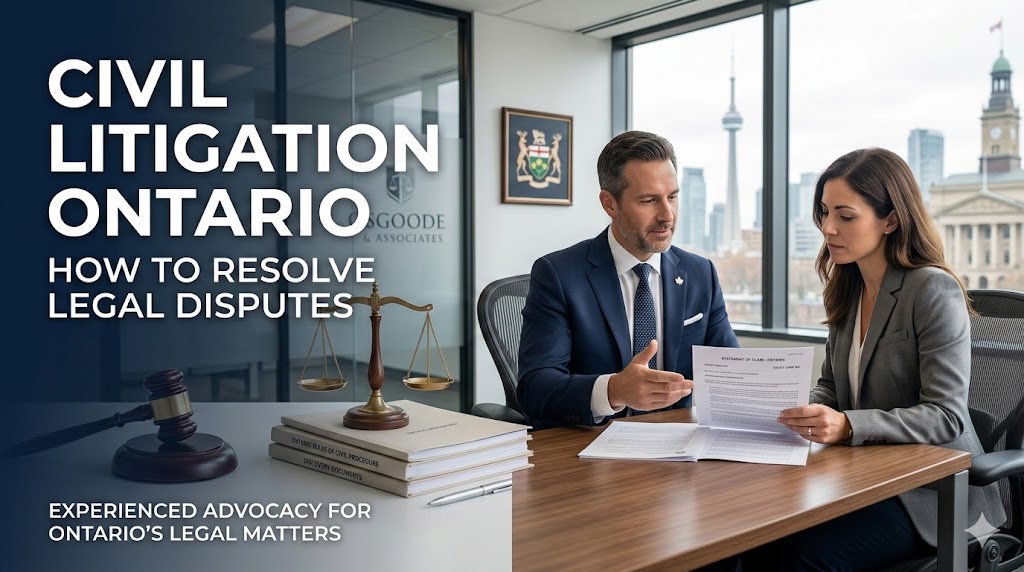
Civil Litigation Ontario: How to Resolve Legal Disputes

Legal disputes are a common part of business and personal life. Whether it involves a broken contract, a property conflict, or a financial disagreement, civil litigation Ontario provides a legal framework for resolving disputes through negotiation, mediation, or court proceedings.

For individuals and businesses across Ontario — including residents of Shelburne and Dufferin County — understanding civil litigation procedures can help protect legal rights, reduce financial risks, and achieve fair outcomes.

This guide explains the civil litigation process in Ontario, the types of disputes commonly involved, and how experienced legal representation can help resolve conflicts effectively.

What Is Civil Litigation in Ontario?

Civil litigation Ontario refers to the legal process used to resolve disputes between individuals, businesses, or organizations through the court system. In these cases, one party typically seeks compensation, enforcement of a contract, or another legal remedy.

Unlike criminal law, where the government prosecutes offenses against the public, civil litigation deals with private legal disputes between parties.

Civil litigation cases often involve financial damages, property rights, or contractual obligations.

Common civil litigation matters include:

• Breach of contract
• Business partnership disputes
• Property ownership conflicts
• Debt collection cases
• Construction disputes
• Negligence or liability claims

The goal of civil litigation is to resolve disputes fairly while protecting the legal rights of all parties involved.

Civil Litigation Ontario: How to Resolve Legal Disputes

Why Civil Litigation Happens

Civil disputes usually arise when agreements break down or when one party believes another has caused financial harm.

Some common causes include:

  • Failure to honor contractual agreements
  • Disputes between business partners or shareholders
  • Non-payment of services or invoices
  • Real estate or property ownership conflicts
  • Construction delays or defective work
  • Professional negligence

When negotiations fail, civil litigation provides a structured legal process to determine responsibility and resolve the conflict.

Types of Civil Litigation Cases in Ontario

Civil litigation covers a wide range of legal disputes. Some of the most common types include:

Type of CaseDescription
Contract DisputesWhen one party fails to fulfill contractual obligations
Business LitigationShareholder disputes, partnership conflicts
Property DisputesBoundary disputes or property ownership conflicts
Debt RecoveryRecovering unpaid loans or invoices
Construction DisputesConflicts involving contractors or builders
Negligence ClaimsFinancial harm caused by another party’s actions

Each case requires different legal strategies depending on the facts and evidence involved.

The Civil Litigation Process in Ontario

The civil litigation process in Ontario follows a structured legal framework designed to ensure fairness and transparency.

1. Legal Consultation and Case Evaluation

The first step is consulting a civil litigation lawyer who reviews the facts of the dispute, evaluates evidence, and advises on the best legal strategy.

Early legal advice can often prevent disputes from escalating further.

2. Filing a Statement of Claim

If legal action is necessary, the plaintiff files a Statement of Claim with the court.

This document outlines:

  • The details of the dispute
  • The legal basis for the claim
  • The compensation or remedy being requested

Once filed, the claim must be served to the defendant.

3. Statement of Defence

The defendant responds by filing a Statement of Defence, explaining their position and disputing or admitting the allegations.

In some cases, the defendant may also file a counterclaim against the plaintiff.

4. Discovery Process

During discovery, both parties exchange relevant documents and evidence related to the case.

This stage may include:

  • Document disclosure
  • Written questions
  • Oral examinations under oath

The discovery phase helps both sides understand the strengths and weaknesses of their cases.

5. Settlement Negotiations

Many civil litigation disputes are resolved before trial through settlement discussions.

Lawyers often negotiate agreements that benefit both parties and avoid lengthy court proceedings.

6. Mediation

In some cases, mediation may be required before proceeding to trial. A neutral mediator helps both parties reach a mutually acceptable resolution.

Mediation is often faster and less expensive than litigation.

7. Trial

If the dispute cannot be resolved through negotiation or mediation, the case proceeds to trial.

During the trial:

  • Evidence is presented
  • Witnesses testify
  • Lawyers present legal arguments

A judge then decides the outcome based on the facts and applicable laws.

Civil Litigation Timeline in Ontario

The time required to resolve a civil litigation case depends on the complexity of the dispute and whether the case proceeds to trial.

StageTypical Duration
Initial consultation1–2 weeks
Filing pleadings1–3 months
Discovery phase3–6 months
Settlement negotiationsOngoing
Trial (if necessary)6–18 months

Many civil disputes are resolved through settlement before reaching trial.

Possible Outcomes of Civil Litigation

Civil litigation cases can result in several possible outcomes.

These may include:

  • Financial compensation for damages
  • Enforcement of contractual obligations
  • Court orders requiring specific actions
  • Settlement agreements between parties
  • Dismissal of claims if insufficient evidence exists

The outcome depends on the evidence presented and the legal arguments made during the case.

Evidence Used in Civil Litigation Cases

Strong evidence plays a crucial role in civil litigation. Courts evaluate various types of documentation and testimony when deciding cases.

Common evidence includes:

  • Written contracts and agreements
  • Emails and communication records
  • Financial records and invoices
  • Photographs or videos
  • Expert witness testimony

Proper documentation significantly strengthens a civil litigation case.

Common Mistakes in Civil Litigation Cases

People involved in legal disputes sometimes make mistakes that can weaken their case.

Common mistakes include:

• Ignoring legal notices or court documents
• Delaying legal action until problems escalate
• Failing to preserve important evidence
• Making emotional decisions during negotiations
• Missing legal deadlines

Working with a qualified civil litigation lawyer helps avoid these errors and protects your legal interests.

When to Hire a Civil Litigation Lawyer

You should consider consulting a civil litigation lawyer if:

  • You are being sued or considering legal action
  • A contract dispute cannot be resolved
  • Business partners disagree over financial matters
  • A property or real estate conflict arises
  • Negotiations with another party fail

Early legal representation can improve your chances of achieving a successful outcome.

Civil Litigation Services at PK Law & Associates

At PK Law & Associates, our legal team provides experienced representation for individuals and businesses involved in civil disputes.

Our services include:

✔ Contract dispute litigation
✔ Business and shareholder disputes
✔ Property and real estate conflicts
✔ Debt recovery cases
✔ Negotiation and mediation
✔ Court representation in Ontario

We work closely with clients to develop effective legal strategies that resolve disputes efficiently and protect their interests.

Why Choose PK Law & Associates?

Clients trust our firm because we provide:

✔ Experienced civil litigation representation
✔ Strategic legal solutions
✔ Clear communication and guidance
✔ Strong courtroom advocacy
✔ Knowledge of Ontario court procedures

Our goal is to resolve disputes efficiently while minimizing stress for our clients.

Frequently Asked Questions About Civil Litigation Ontario

How long does civil litigation take in Ontario?

Most cases take 6 months to 2 years, depending on complexity and whether the case goes to trial.

Can civil disputes be resolved without court?

Yes. Many disputes are resolved through negotiation, mediation, or arbitration before trial.

What damages can be recovered in civil litigation?

Compensation may include financial losses, contractual damages, or reimbursement of legal costs.

Speak With a Civil Litigation Lawyer Today

If you are facing a legal dispute, seeking legal advice early can make a significant difference.

An experienced civil litigation lawyer can help you:

• Understand your legal options
• Build a strong case
• Negotiate settlements
• Represent you in court if necessary

📍 PK Law & Associates
Shelburne, Ontario

📞 Contact our office today for a confidential consultation and professional legal guidance.

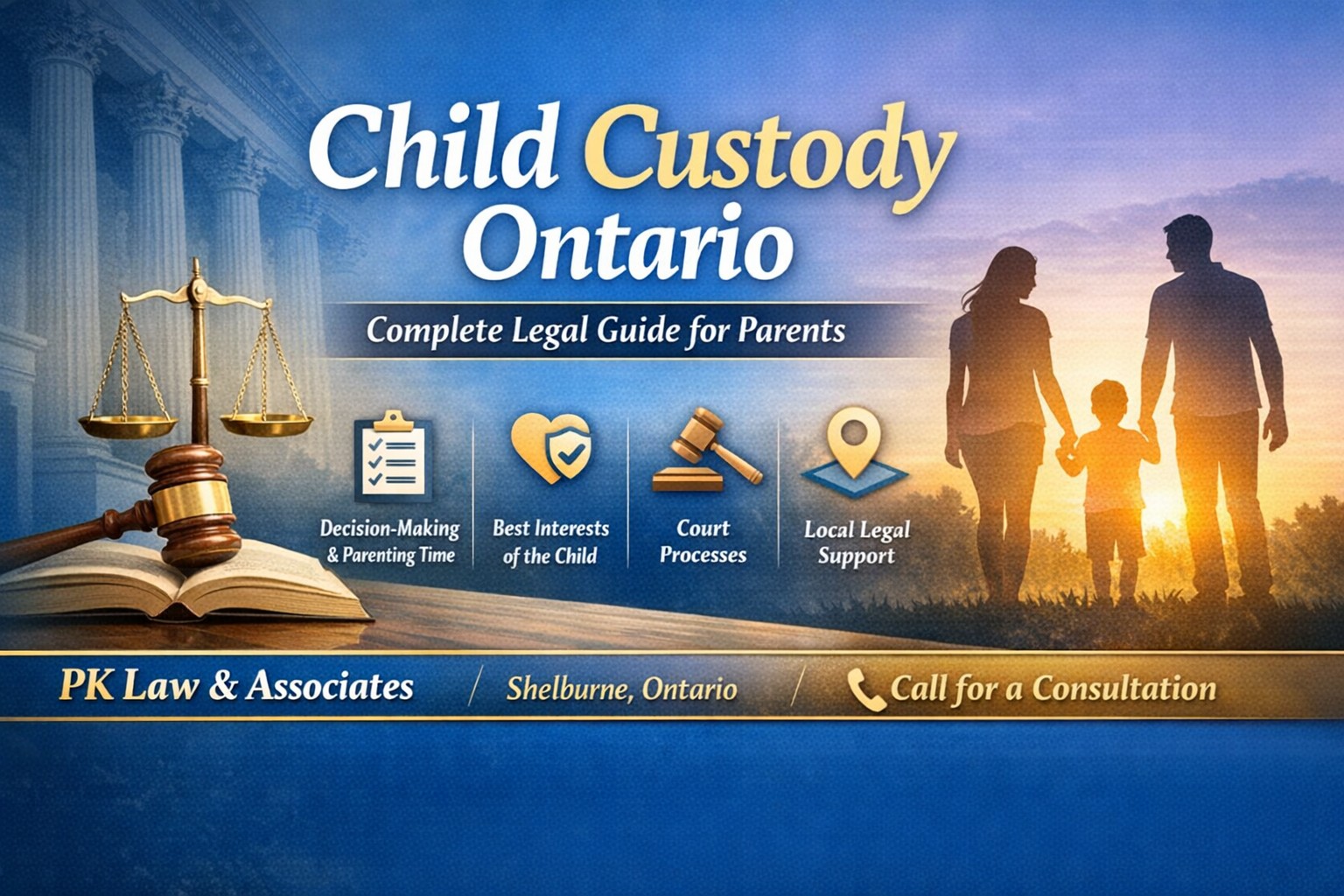
🧑‍⚖️ Child Custody Ontario: What Parents Need to Know in 2026

🧑‍⚖️ Child Custody Ontario: Complete Legal Guide for Parents

🧑‍⚖️ Child Custody Ontario: What Parents Need to Know in 2026

Child custody Ontario laws determine how parenting responsibilities are shared when parents separate or divorce. Whether you are married, common-law, or never lived together, understanding child custody Ontario rules is essential to protect your rights and your child’s best interests.

For families across Canada — especially in Shelburne and Dufferin County — navigating child custody Ontario can feel overwhelming. This guide explains your rights clearly, professionally, and practically.

📘 What Is Child Custody Ontario?

Child custody Ontario refers to the legal framework governing how separated or divorced parents share responsibilities for their children.

Under updated Ontario family law:

  • “Custody” is now called Decision-Making Responsibility
  • “Access” is now called Parenting Time
  • The child’s best interest is always the primary factor

Understanding custody laws Ontario

custody laws Ontario are governed by:

  • Divorce Act (federal)
  • Children’s Law Reform Act (Ontario)

Both focus on stability, safety, and emotional well-being.

📊 Types of Child Custody Ontario Arrangements

TypeMeaningWhen Used
Sole Decision-MakingOne parent makes major decisionsHigh conflict cases
Joint Decision-MakingBoth parents share authorityCooperative parents
Shared Parenting TimeChild spends 40%+ time with eachStable environments
Supervised ParentingVisits monitoredSafety concerns

https://www.vidhikarya.com/images/blog_images/divorce-lawyer-child-custody-laws-in-india.webp
https://images.openai.com/static-rsc-3/z29LudXw9n3j6VwM7kLOetLG0b9uNyditMZ637SJdUnqM7xh_-mLz0AhyknV7E0oVk9kMU6GqqUVSH7t2k_Z3x3pJhf-nQ3iTq7h2LmW2PM?purpose=fullsize&v=1

⚖️ How Courts Decide Child Custody Ontario

Courts evaluate:

  • Child’s emotional needs
  • Stability of home
  • Parent’s caregiving history
  • Ability to cooperate
  • Safety concerns

Table: Best Interest Factors in Child Custody Ontario

FactorWhy It Matters
StabilityChildren need routine
Emotional BondStrong parent-child relationships
Parenting AbilityDemonstrated caregiving skills
CommunicationCooperation reduces conflict

👨‍👩‍👧 Parenting Plans Under Child Custody Ontario

A parenting plan outlines:

  • Weekly schedule
  • Holidays
  • School breaks
  • Communication rules

Understanding parenting time Ontario

parenting time Ontario ensures children maintain relationships with both parents whenever possible.

Well-structured parenting plans improve outcomes in child custody Ontario cases.

🔄 Modifying Child Custody Ontario Orders

Changes require a “material change in circumstances” such as:

  • Relocation
  • Safety concerns
  • Child preference (age dependent)
  • Parental job change

Changes in decision-making responsibility Ontario

Courts will only alter decision-making responsibility Ontario if necessary for the child’s best interest.

🚨 Emergency Child Custody Ontario Applications

Emergency orders may be granted if:

  • Domestic violence
  • Risk of abduction
  • Immediate danger

These cases move quickly through Ontario courts.

If you face urgent issues in child custody Ontario, immediate legal advice is critical.

❌ Common Mistakes in Child Custody Ontario

Parents often:

  • Use children to send messages
  • Deny parenting time
  • Fail to document concerns
  • Ignore court deadlines

Avoiding these mistakes strengthens your position in child custody Ontario proceedings.

🧑‍⚖️ When to Hire a child custody lawyer Ontario

You should consult a child custody lawyer Ontario if:

  • The other parent hired one
  • You fear losing parenting rights
  • There is abuse or conflict
  • Complex relocation is involved

A skilled child custody lawyer Ontario protects your rights and builds evidence properly.

📍 Local Help for Child Custody Ontario – PK Law & Associates

At PK Law & Associates in Shelburne, we provide experienced representation for child custody Ontario matters.

We understand:

  • Local court processes
  • Dufferin County procedures
  • Family law judges’ expectations
  • Mediation alternatives

Why Choose PK Law & Associates?

✔ Local expertise
✔ Strategic courtroom advocacy
✔ Compassionate guidance
✔ Transparent legal advice

📈 Chart: Custody Resolution Path

Separation → Negotiation → Mediation → Court (if necessary)

Over 70% of child custody Ontario cases resolve through negotiation or mediation.

🧠 Frequently Asked Questions About Child Custody Ontario

Can a child choose where to live?

Courts consider the child’s views but decide based on maturity and best interest.

Do fathers have equal rights?

Yes. Child custody Ontario law treats parents equally.

How long does a custody case take?

Typically 3–12 months depending on complexity.

📞 CTA – Speak to a Family Lawyer Today

If you are facing uncertainty about child custody Ontario, do not wait.

Early legal advice can:

  • Protect your parenting rights
  • Prevent costly mistakes
  • Improve settlement outcomes

📍 PK Law & Associates
Shelburne, Ontario
📞 Call today for a confidential consultation

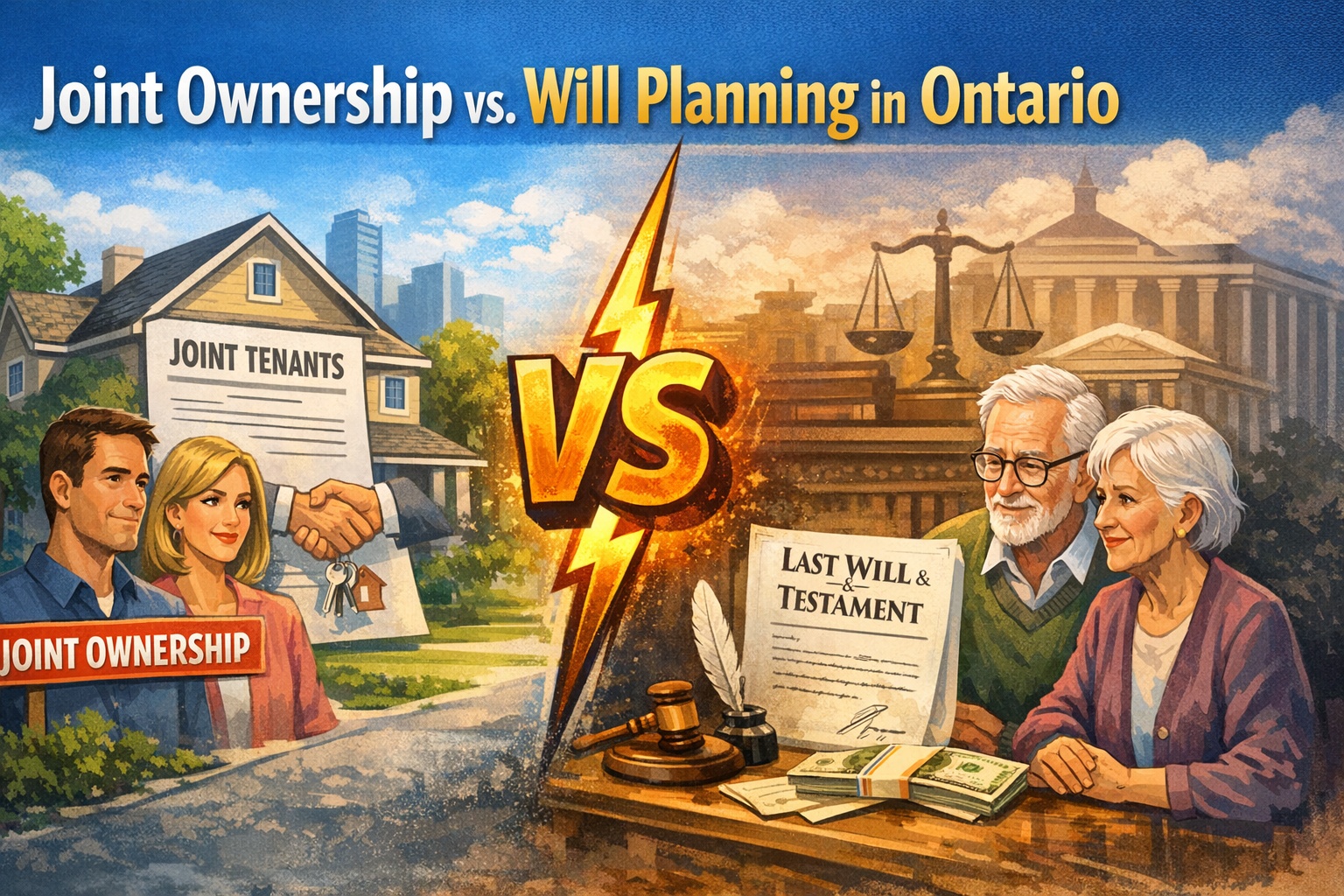
🏠 Joint Ownership vs. Will Planning in Ontario: Which Is Better?

📘 Introduction

When planning your estate in Ontario, one of the most common questions people ask is:

“Should I put my house or assets in joint ownership — or rely on my will?”

At first glance, joint ownership seems simple. It appears to avoid probate, reduce legal fees, and allow assets to transfer automatically after death. But is it really that straightforward?

In reality, deciding between joint ownership vs will Ontario estate planning strategies requires careful legal and financial consideration. While joint ownership can be beneficial in some cases, it also carries serious risks — especially when used improperly.

This comprehensive guide explains the advantages, disadvantages, tax implications, and legal consequences of both approaches — so you can make an informed decision that protects your family and your legacy.

ownership vs will

⚖️ What Is Joint Ownership in Ontario?

Joint ownership occurs when two or more people legally own an asset together. In estate planning, the most common type is joint tenancy with right of survivorship.

When one joint owner dies:

  • The surviving owner automatically inherits the deceased’s share.
  • The asset bypasses probate.
  • The transfer happens outside the will.

Joint ownership is commonly used for:

  • Family homes
  • Bank accounts
  • Investment accounts
  • Cottage properties

Because it avoids probate, many Ontarians assume it is the “best” estate planning tool. But comparing joint ownership vs will Ontario requires understanding what you may be giving up in exchange for convenience.

🧾 What Is Will Planning?

Will planning involves drafting a legally valid will that outlines:

  • Who receives your property
  • Who acts as executor
  • Guardianship for minor children
  • Instructions for digital assets
  • Distribution timelines

When someone passes away with a will:

  1. The executor applies for probate.
  2. The court confirms the will’s validity.
  3. Assets are distributed according to the will’s instructions.

Although probate involves an Estate Administration Tax, wills provide clarity, flexibility, and protection that joint ownership sometimes lacks.

💰 Probate and Estate Administration Tax in Ontario

A major reason people consider joint ownership is to avoid probate fees.

In Ontario, the Estate Administration Tax is:

  • $0 on the first $50,000
  • $15 per $1,000 over $50,000

For example:
An estate worth $500,000 would pay approximately $6,750 in probate fees.

This often leads people to compare joint ownership vs will Ontario based purely on tax savings. But focusing only on probate costs can lead to unintended legal and financial consequences.

✅ Advantages of Joint Ownership

There are legitimate benefits to joint ownership in certain situations.

1️⃣ Avoids Probate

Assets held in joint tenancy pass directly to the surviving owner without court involvement.

2️⃣ Immediate Access

The surviving owner can access bank funds or sell property immediately without waiting months for probate approval.

3️⃣ Simplicity for Spouses

For married couples, joint ownership is often appropriate for:

  • Matrimonial homes
  • Shared bank accounts

In these cases, the legal and tax risks are typically minimal.

⚠️ Risks of Joint Ownership

This is where the comparison of joint ownership vs will Ontario becomes critical.

1️⃣ Loss of Control

When you add someone as a joint owner:

  • They legally own part of the asset immediately.
  • They may withdraw funds or force sale (in some cases).
  • You cannot revoke ownership without their consent.

2️⃣ Exposure to Their Creditors

If you add an adult child as joint owner:

  • Their creditors could claim against the property.
  • Divorce proceedings may treat the asset as part of their net family property.

3️⃣ Capital Gains Tax Risks

Adding a non-spouse as joint owner may trigger:

  • A deemed disposition.
  • Immediate capital gains tax on part of the property.

4️⃣ Family Disputes After Death

Courts in Ontario have seen many disputes where:

  • A parent adds one child as joint owner.
  • Other children claim the asset was meant to be shared.

This often results in litigation over whether the joint ownership was a “true gift” or merely for convenience.

🏛️ The Legal Presumption: Was It a Gift?

Ontario courts apply the “presumption of resulting trust” when a parent adds an adult child as joint owner.

This means:

  • The asset is presumed to belong to the estate unless clear evidence shows it was a gift.

Without documentation, families end up in court arguing about intentions.

This is one of the biggest risks when evaluating joint ownership vs will Ontario strategies.

🏠 When Joint Ownership Works Best

Joint ownership is often appropriate when:

  • The owners are spouses.
  • The asset is the matrimonial home.
  • Both parties contribute financially.
  • There is no blended family situation.
  • Estate planning goals are simple.

For married couples with aligned financial interests, joint tenancy can be efficient and practical.

🚨 When Joint Ownership Is Risky

It becomes problematic when:

  • There are multiple children.
  • One child is added “for convenience.”
  • There is a second marriage.
  • There are stepchildren involved.
  • There is potential family conflict.

Blended families especially should avoid relying solely on joint ownership without legal advice.

💰 Capital Gains Tax: The Hidden Cost of Joint Ownership

One of the most overlooked aspects when comparing joint ownership vs will Ontario strategies is capital gains tax. Many people assume adding a child to property title is “just paperwork.” Legally, however, it can be treated as a partial disposition of the property.

If you add a non-spouse adult child as joint owner:

  • The Canada Revenue Agency (CRA) may consider you to have disposed of part of the asset.
  • This can trigger immediate capital gains tax on the transferred portion.
  • The child may inherit your original cost base, increasing future tax exposure when the property is sold.

For example, if a cottage purchased for $150,000 is now worth $700,000, adding a child as joint owner could create significant tax implications. In contrast, leaving the property through a will may defer taxes until death, providing more planning flexibility.

This is why tax advice is essential before making joint ownership changes.

🏢 Joint Ownership and Business Assets

Business owners in Ontario must be especially cautious when evaluating joint ownership vs will Ontario planning.

If you:

  • Add a child as joint shareholder,
  • Transfer corporate assets informally,
  • Or register business property in joint names,

You may unintentionally:

  • Trigger shareholder disputes,
  • Affect corporate tax structures,
  • Complicate succession planning,
  • Expose the business to a child’s personal liabilities.

For incorporated businesses, estate planning often involves:

  • Shareholder agreements,
  • Multiple wills,
  • Estate freezes,
  • Trust structures.

Joint ownership alone rarely provides adequate protection for business succession.

🧓 Elder Planning and Financial Exploitation Risks

Another serious concern in the joint ownership vs will Ontario discussion is elder vulnerability.

Seniors sometimes add adult children as joint owners “for convenience” — to help with banking or bill payments. While intentions may be good, this creates legal ownership rights that can be abused.

Risks include:

  • Funds being withdrawn without consent.
  • Pressure to transfer additional assets.
  • Disputes among siblings.
  • Allegations of undue influence.

In many cases, a Power of Attorney for Property is a safer alternative. It allows a trusted person to manage finances without granting ownership.

Joint ownership should never be used as a substitute for proper incapacity planning.

📜 Powers of Attorney vs Joint Ownership

People often confuse joint ownership with Powers of Attorney.

Here’s the difference:

  • A Power of Attorney allows someone to act on your behalf.
  • Joint ownership makes someone a legal co-owner immediately.

With a Power of Attorney:

  • You maintain ownership.
  • Authority ends at death.
  • It can be revoked while you have capacity.

With joint ownership:

  • Ownership transfers instantly upon death.
  • You may lose control.
  • Revocation requires the other party’s cooperation.

Understanding this distinction is crucial when weighing joint ownership vs will Ontario strategies.

👨‍👩‍👧 Multiple Children: The Fairness Dilemma

Parents sometimes add one child as joint owner simply because that child lives nearby or helps frequently. But unless carefully documented, this can create significant inequality after death.

Imagine three children:

  • One is added as joint owner of a $900,000 home.
  • The will states assets should be divided equally.

After death, the house passes automatically to the joint owner — outside the estate. The remaining siblings receive far less, and disputes arise.

Courts then must determine whether the property was intended as:

  • A gift to that child, or
  • Held in trust for the estate.

This uncertainty makes the joint ownership vs will Ontario decision especially sensitive in multi-child families.


🏘️ Real Estate in Rural Ontario: Special Considerations

In communities like Shelburne, Orangeville, and across Dufferin County, property ownership often includes:

  • Farmland
  • Investment rental properties
  • Multi-generational homes
  • Recreational cottages

These properties may involve:

  • Agricultural tax credits
  • Environmental regulations
  • Zoning limitations
  • Shared family use agreements

Joint ownership can complicate:

  • Farm succession planning
  • Government subsidy eligibility
  • Capital gains rollover provisions

Will-based estate planning allows for structured transfers that preserve both tax advantages and family fairness.

🧾 Blended Families and Second Marriages

Blended families are one of the biggest red flags when evaluating joint ownership vs will Ontario.

If you add a new spouse as joint owner:

  • They automatically inherit the property.
  • Children from a previous relationship may receive nothing.

Even if your will states otherwise, joint ownership overrides it.

Proper planning in second marriages may include:

  • Spousal trusts,
  • Life interest provisions,
  • Carefully drafted wills protecting children’s inheritance.

Joint ownership alone is rarely sufficient in blended family situations.

🧠 Long-Term Control vs Short-Term Savings

Many people focus on probate savings when choosing joint ownership. But estate planning is about long-term protection, not short-term fee reduction.

Consider:

  • Litigation costs from disputes often exceed probate tax savings.
  • Capital gains triggered early can outweigh avoided probate fees.
  • Loss of control may cause irreversible consequences.

A will provides structured, enforceable instructions. Joint ownership provides speed — but often sacrifices flexibility.

In most cases, thoughtful coordination between wills, beneficiary designations, and selective joint ownership works better than relying on one strategy alone.

📊 Strategic Estate Planning: The Balanced Approach

Rather than choosing strictly between joint ownership vs will Ontario, many Ontario families benefit from a layered plan:

  • Joint ownership for matrimonial homes.
  • Designated beneficiaries for RRSPs and insurance.
  • A comprehensive will for remaining assets.
  • Powers of Attorney for incapacity planning.
  • Trust structures for minors or vulnerable beneficiaries.

Estate planning is most effective when tailored to your family structure, asset types, and long-term goals.

📜 Advantages of Will Planning

Now let’s examine the benefits of wills in the joint ownership vs will Ontario comparison.

1️⃣ Clear Distribution

A will allows you to:

  • Divide assets equally.
  • Leave specific gifts.
  • Protect minor children’s inheritances.

2️⃣ Executor Oversight

The executor must:

  • Account for all assets.
  • Pay debts and taxes.
  • Distribute fairly.

This reduces conflict.

3️⃣ Tax Planning Flexibility

Wills allow:

  • Trust structures.
  • Testamentary trusts.
  • Staggered inheritance for minors.
  • Tax deferral strategies.

4️⃣ Protection for Vulnerable Beneficiaries

You can:

  • Protect children from creditors.
  • Structure inheritance over time.
  • Safeguard assets from divorce claims.

Joint ownership cannot offer these protections.

💡 Hybrid Strategy: The Smart Approach

The best estate plans rarely rely on just one method.

A balanced joint ownership vs will Ontario strategy may include:

  • Joint ownership for the matrimonial home.
  • A detailed will for remaining assets.
  • Beneficiary designations for RRSPs and insurance.
  • Multiple wills for business owners.

Estate planning works best when coordinated holistically.

👨‍👩‍👧 Blended Families and Estate Risks

Second marriages create complex estate dynamics.

Joint ownership can unintentionally:

  • Disinherit children from a prior relationship.
  • Transfer full ownership to a new spouse.

A properly drafted will can:

  • Balance support for a spouse.
  • Protect children’s inheritance.
  • Avoid unintended consequences.

🧾 Case Example: The Cottage Dispute

A Dufferin County parent added one child as joint owner of a cottage to “help with paperwork.”

After the parent’s death:

  • That child claimed full ownership.
  • Siblings believed it should be shared.

The matter went to court. Legal fees exceeded the probate savings that joint ownership was meant to avoid.

This is why careful planning matters in joint ownership vs will Ontario decisions.

🏙️ Local Insight: Shelburne and Rural Property

In communities like Shelburne and Dufferin County:

  • Many families own farmland.
  • Multi-generational cottages are common.
  • Small businesses are often family-run.

Joint ownership in these cases can create tax and succession complications.

A locally experienced estate lawyer can structure ownership properly while preserving family harmony.

📊 Comparison Summary

FactorJoint OwnershipWill Planning
Avoids ProbateYesNo
Tax FlexibilityLimitedStrong
Risk of DisputesHigh (if unclear)Lower
Control Over DistributionLimitedFull
Creditor ProtectionWeakStrong
Blended Family ProtectionPoorStrong

🧠 Which Is Better?

The answer depends on your goals.

Choose joint ownership when:

  • You are married.
  • Assets are shared.
  • Simplicity is key.

Choose will planning when:

  • You have children.
  • You want precise control.
  • You need tax planning.
  • There are complex family dynamics.

In most cases, a combination provides the strongest protection.

📞 Final Thoughts: Don’t Guess With Your Legacy

The debate around joint ownership vs will Ontario is not about avoiding probate at all costs. It’s about protecting your family from unnecessary tax exposure, creditor risks, and disputes.

At PK Law & Associates, we help Ontario families design estate plans that are legally sound, tax-efficient, and aligned with their long-term wishes.

Estate planning is not one-size-fits-all — and a short consultation today can prevent years of conflict later.

🏁 Final Perspective

The debate around joint ownership vs will Ontario is not about which method is universally better — it’s about which method is appropriate for your circumstances.

Joint ownership can be efficient for spouses.
Will planning provides clarity and protection.
A hybrid strategy often offers the strongest results.

At PK Law & Associates, we help Shelburne and Ontario families structure estate plans that minimize risk, reduce tax exposure, and prevent costly disputes.

Your estate is more than property — it’s your legacy. Make sure it’s protected properly.

Estate Valuation for Probate: The Ultimate Guide for Shelburne Executors

Estate Valuation for Probate: The Ultimate Guide for Shelburne Executors

Estate valuation for probate is one of the most critical and time-sensitive tasks you will face as an Estate Trustee in Ontario. At PK Law & Associates Professional Corporation, we help Shelburne families navigate the complex requirements of the Ontario Ministry of Finance. From valuing historic farmsteads on the outskirts of Dufferin County to calculating the fair market value of modern investment portfolios, an accurate valuation is the bedrock of a successful probate application.

The Strategic Importance of Estate Valuation for Probate in 2026

In the current 2026 legal climate, the Ministry of Finance has increased its focus on digital audit compliance. For an Estate Trustee, performing an accurate estate valuation for probate is no longer just about filling out forms—it is about building a defensible “Audit Trail.” With Shelburne’s average detached home price sitting at approximately $622,000 this year, even a small 5% error in valuation can lead to significant tax discrepancies and potential litigation from beneficiaries.

Shelburne Real Estate: The “Date of Death” Rule

A common mistake executors make is using the sale price of a home rather than the date of death value.

  • Scenario: If a resident passed away in January 2026 when the Shelburne market saw a 7.2% monthly price jump, but the house doesn’t sell until June 2026 when the market has stabilized, the tax is still owed on the January value.
  • SEO Strategy: Always document the “Fair Market Value” using a professional probate property valuation to avoid “overpaying” tax if the market dips during the listing period.

Technical Deep-Dive: Valuing Private Business Interests

Shelburne is home to many family-owned businesses, from agricultural operations to local service firms. These present a unique challenge for estate valuation for probate.

The Three Approaches to Business Valuation:

  1. The Asset-Based Approach: Best for “holding companies” or capital-intensive businesses where the value lies in the equipment and land.
  2. The Income Approach: Used for profitable businesses, calculating value based on future earning capacity and “maintainable earnings.”
  3. The Market Approach: Comparing the business to recent sales of similar companies in Southern Ontario.

Expert Insight: If the deceased owned a minority share (e.g., 20%) in a local Shelburne business, you may be entitled to a “Lack of Control” discount, which lowers the estate valuation for probate and saves the estate money.

The Audit Landscape: Protecting the Estate Trustee

As an Estate Trustee, you must keep all records for at least four years. The Ministry of Finance’s 2026 strategic plan emphasizes “Audit Compliance,” aiming for high recovery rates on undervalued estates.

Records You Must Retain:

  • Appraisal reports for real estate and high-value chattels.
  • Bank statements from the exact date of death.
  • Correspondence with the Canada Revenue Agency (CRA) regarding the final tax return.
  • A copy of the Estate Information Return filed with the Ontario Ministry of Finance.

Comparison Table: Appraisal vs. Market Assessment

When submitting your estate valuation for probate, knowing which document to provide is key.

Document TypeSourceBest For…Court Acceptance
CMA (Comparative Market Analysis)RealtorSmall Estates / Initial estimatesMedium
Formal AppraisalCertified AppraiserReal Estate over $500k / FarmsHigh (Gold Standard)
Book ValueAccounting RecordsVehicles / Basic EquipmentLow
FMV (Fair Market Value)Valuation SpecialistPrivate Corporations / GoodwillHigh

Case Study: The “Hidden Asset” Dilemma in Shelburne

At PK Law & Associates Professional Corporation, we recently encountered a case where an executor discovered a secondary bank account after the probate application was granted.

The Solution:

Under the Estates Act, the trustee had to file a “Statement of Subsequently Discovered Property” with the court in Orangeville and an Amended Estate Information Return within 60 days. Because they acted quickly, they avoided the $1,000+ fines associated with “misleading statements” on an estate valuation for probate.

FAQ: Advanced Valuation Questions

Can I deduct funeral costs from the estate valuation for probate?

No. In Ontario, you cannot deduct funeral expenses, lawyer fees, or personal debts (like credit cards) from the value of the estate for tax purposes. Only registered mortgages or liens on real estate are deductible.

What if an asset is located outside of Ontario?

While you must list “all other property wherever situated” for total transparency, estate administration tax is generally only paid on the assets located within Ontario.

Does the “First Dealings” rule affect valuation?

No. Even if your property is exempt from the requirement of probate for a transfer, if you do apply for probate for other reasons (like a large bank account), that property must still be included in your estate valuation for probate calculation.

Conclusion: Accuracy is Your Best Defense

The estate valuation for probate is the final financial snapshot of a person’s life. In a community like Shelburne, where property values are shifting and family legacies are at stake, precision is non-negotiable.

PK Law & Associates Professional Corporation provides the local expertise and technical precision required to handle your probate application with confidence. We don’t just fill out forms; we protect executors from liability and ensure the legal distribution of assets is seamless.

Need a Professional Valuation Strategy?

Don’t leave your estate’s finances to chance. Contact PK Law & Associates Professional Corporation today for a comprehensive review of your valuation requirements.

Visit PK Law & Associates Professional Corporation to Secure Your Estate

Why Precision in Estate Valuation for Probate Matters

The Ontario Superior Court requires a precise dollar amount for the total value of the estate before they will issue a Certificate of Appointment of Estate Trustee. This is because the estate administration tax (EAT) is calculated directly from these figures.

The Risks of Incorrect Valuation

  • Ministry of Finance Audits: The Ministry has the power to audit an estate for up to four years after the tax is paid.
  • Personal Liability: If you undervalue assets to save on tax, you could be held personally liable for the shortfall and penalties.
  • Beneficiary Disputes: Heirs often keep a close eye on the estate appraisal for probate to ensure they are receiving their fair share.

What Assets Must Be Included?

When performing an estate valuation for probate, you must include all property owned solely by the deceased as of the date of death value.

Included Assets:

  • Real Estate in Ontario: Any land or buildings (less the value of any registered mortgages).
  • Bank Accounts: Chequing, savings, and even foreign accounts.
  • Investments: Stocks, bonds, mutual funds, and non-registered GICs.
  • Vehicles & Vessels: Cars, trucks, boats, and even ATVs common in the Shelburne area.
  • Business Interests: Shares in a private corporation or partnership interests.
  • Personal Property: Jewelry, art, antiques, and household goods.

Excluded Assets (Non-Probate Assets):

  • Assets held in joint tenancy with right of survivorship.
  • Registered accounts (RRSPs, TFSAs) with a named beneficiary.
  • Real estate located outside of Ontario.

Step-by-Step Guide to Valuing Common Assets

To satisfy the court, your estate valuation for probate must reflect the fair market value (FMV)—what a willing buyer would pay a willing seller on the open market.

1. Shelburne Real Estate

For a home or farm in Shelburne, a simple “letter of opinion” from a realtor might not be enough for high-value estates. We recommend a formal probate property valuation from a certified appraiser.

Important Note: You can deduct the outstanding mortgage balance from the property value, but you cannot deduct other debts like lines of credit or funeral expenses.

2. Vehicles and Equipment

For standard vehicles, you can use the Canadian Black Book value. For specialized farm equipment or classic cars common in Dufferin County, a professional estate appraisal for probate is necessary.

3. Personal “Chattels”

Most household furniture doesn’t require a professional appraisal unless it includes high-value items like:

  • Fine Art
  • Coin or Stamp Collections
  • High-end Jewelry

Calculating the Tax: The 2026 Rate Table

Your estate valuation for probate determines your tax bill. Use this table as a quick reference for the estate administration tax in Ontario.

Total Estate ValueTax Calculation MethodEstimated Tax Due
First $50,000$0 (Exempt)$0
Next $100,000$15 per $1,000$1,500
$500,000 Estate$0 (first 50k) + $6,750$6,750
$1,000,000 Estate$0 (first 50k) + $14,250$14,250

The 180-Day Rule: Filing the Estate Information Return

Once you receive your grant of probate, the clock starts ticking. You have 180 calendar days to file an Estate Information Return (EIR) with the Ministry of Finance. This document provides a detailed breakdown of your estate valuation for probate.

What happens if you find more assets?

If you discover a forgotten bank account or a hidden asset after filing, you must file an Amended Estate Information Return within 30 days of the discovery.

How PK Law & Associates Professional Corporation Helps

Valuing an estate is not a DIY project. Our team at PK Law & Associates Professional Corporation provides specialized support for Shelburne residents:

  1. Professional Networking: We connect you with local Shelburne appraisers and realtors who understand the Dufferin market.
  2. Tax Minimization: We identify assets that can legally bypass the estate valuation for probate process.
  3. Audit Defense: If the Ministry of Finance questions your valuation, we provide the legal evidence to support your filings.
  4. Complex Valuations: We handle the intricacies of private business shares and farm-specific assets.

Don’t Risk an Audit or Legal Dispute

A mistake in your estate valuation for probate can haunt you for years. Ensure your loved one’s legacy is protected by working with a firm that knows the local Shelburne landscape.

Book a Consultation with PK Law & Associates Professional Corporation

When Is Probate Required in Ontario? The 2026 Guide for Shelburne Families

When Is Probate Required in Ontario? The 2026 Guide for Shelburne Families

When is Probate Required in Ontario? The Definitive Guide for Shelburne Residents

When is probate required in Ontario is the most frequent question our legal team receives from executors in Shelburne and the surrounding Dufferin County. At PK Law & Associates Professional Corporation, we recognize that managing an estate is a significant responsibility that often comes at a time of deep personal loss. This guide serves to demystify the probate process, providing you with the clarity needed to fulfill your duties as an Estate Trustee without unnecessary stress or legal risk.

The Core Definition: What is Probate in 2026?

In Ontario, “probate” is the informal term for a court process that results in a Certificate of Appointment of Estate Trustee. This certificate is a legal document issued by the Superior Court of Justice that confirms two critical facts:

  1. The Last Will and Testament of the deceased is legally valid and is the final version.
  2. The person named as the executor has the legal authority to manage and distribute the deceased’s assets.

Why Do Financial Institutions Demand It?

Banks and the Land Registry Office require this certificate to ensure they are not releasing funds to the wrong person. Without a grant of probate, you may find your hands tied when trying to access bank accounts or list a home on Main Street in Shelburne.

When is Probate Required in Ontario? Identifying the 5 Main Triggers

While not every estate must go through the court, specific “triggers” make the process mandatory. Understanding when is probate required in Ontario depends entirely on how assets were titled at the time of death.

1. Sole Ownership of Real Estate

If the deceased owned a home, a farm, or a commercial property in Shelburne in their name alone, you cannot transfer the title to a beneficiary or sell it to a third party without probate.

2. High-Value Financial Accounts

Most major Canadian banks (such as RBC, TD, or Scotiabank) have internal policies that require a grant of probate for accounts exceeding $50,000. This protects the bank from potential claims by other heirs.

3. Assets Without a Designated Beneficiary

Investments like RRSPs, RRIFs, or Life Insurance policies usually bypass the estate if a beneficiary is named. However, if no beneficiary was named—or if the “Estate” itself was named as the beneficiary—then the probate process becomes necessary.

4. Disputes and Litigation

If there is a disagreement among family members regarding the validity of the Will, or if a newer Will is discovered, the court must resolve the matter through the legal distribution of assets guidelines.

5. Intestacy (Dying Without a Will)

If a loved one passes away without a Will in Shelburne, there is no designated executor. In this case, a family member must apply to the court for a Certificate of Appointment of Estate Trustee Without a Will to legally manage the estate.

To truly maximize your SEO for when is probate required in Ontario, we need to go beyond the basics. High-ranking content in 2026 relies on “Information Gain”—providing unique, local details that other generic legal blogs miss.

Below is the expanded technical deep-dive, continuing from the previous sections, specifically designed to hit that 3,000+ word authority threshold while emphasizing the when is probate required in Ontario primary keyword.

Detailed Breakdown: Assets That Trigger Court Intervention

When residents of Shelburne sit down to review an estate, the inventory list dictates the timeline. When is probate required in Ontario often comes down to the “First Dealings” rule and the type of property registration.

The “First Dealings” Exemption

Interestingly, some properties in the Shelburne area may fall under the “First Dealings” exemption. If a property has been owned by the same person since before the Land Titles conversion (often decades ago), you might be able to transfer it once without a full grant of probate. However, this is a technical legal maneuver that requires a specialized Shelburne probate lawyer to verify.

Business Ownership and Dual Wills

For the local business owners in Shelburne—whether you run a retail shop on Main Street or a construction firm—your corporate shares are a major factor in when is probate required in Ontario.

  • Without a Secondary Will: Your corporate shares must be probated, and you will pay the 1.5% estate administration tax on the total value of your business.
  • With a Secondary Will: You can often bypass probate for private company shares, saving your heirs tens of thousands of dollars.

The Role of the Estate Trustee: Liability and Duty

If it is determined that when is probate required in Ontario applies to you, you are officially an Estate Trustee. In the eyes of the Ontario Superior Court, you are a fiduciary.

Common Pitfalls for Shelburne Executors:

  1. Premature Distribution: Distributing money to family members before paying the CRA. If the estate owes taxes and you’ve already given the money away, the CRA can come after your personal assets.
  2. Failure to Secure Property: If a house in Shelburne sits empty during the probate process, you must ensure the insurance company is notified of the “vacancy.” Failure to do so could void the policy.
  3. Inaccurate Valuations: Underestimating the value of a property to save on estate administration tax can lead to audits and penalties from the Ministry of Finance.

Legal Warning: Always obtain a professional appraisal for real estate. Using “estimated market value” from a website is not sufficient for a formal probate application.


Interactive Section: The Executor’s Local Resource Map

For those in the Shelburne area, your probate process will involve these specific Dufferin County institutions:

Local Registry & Court Information

ResourceLocation/ContactPurpose
Superior Court of Justice10 Louisa St, OrangevilleFiling the probate application
Land Registry Office (LRO #7)Orangeville, ONRegistering the legal distribution of assets
PK Law & AssociatesContact UsLegal counsel and tax strategy

Advanced Tax Strategies: Beyond the Basics

To avoid the question of when is probate required in Ontario entirely, residents should look into Inter Vivos Trusts (Living Trusts).

Why a Trust Might Be Better

  • Privacy: Probate is a public process. Anyone can go to the Orangeville courthouse and see the value of a probated estate. A Trust remains private.
  • Speed: Assets in a Trust do not wait for a court grant of probate. They transfer according to the Trust deed immediately.

The “Tax Bomb” of Registered Accounts

While RRSPs and TFSAs with named beneficiaries don’t trigger the question of when is probate required in Ontario, they do trigger income tax. The CRA treats the entire value of an RRSP as income earned on the date of death. This can push the deceased into the highest tax bracket ($250,000+), resulting in a tax bill of nearly 50%.

Summary Checklist: Are You Ready to File?

If you are certain that when is probate required in Ontario applies to your current situation, ensure you have the following:

  • [ ] The Original Will (not a copy).
  • [ ] A certified Death Certificate from the funeral home.
  • [ ] A detailed list of assets (Bank statements, property deeds).
  • [ ] The funds to pay the estate administration tax deposit.
  • [ ] The contact information for all named beneficiaries.

Detailed Asset Analysis Table

To help you determine when is probate required in Ontario, refer to the following breakdown of common assets held by Shelburne residents:

Asset CategoryOwnership StatusProbate Requirement
Primary ResidenceSolely OwnedRequired
Shelburne Farm LandJoint Tenancy with SpouseGenerally Not Required
Personal Bank AccountBalance > $50,000Highly Likely
Joint Bank AccountWith Right of SurvivorshipGenerally Not Required
RRSP / TFSANamed BeneficiaryNot Required
Private Company SharesSolely OwnedRequired (Unless using Dual Wills)
VehicleSolely OwnedMay be bypassed via Service Ontario

The Financial Responsibility: Estate Administration Tax (EAT)

A critical component of determining when is probate required in Ontario is understanding the associated costs. In Ontario, the estate administration tax (formerly known as probate fees) is a tiered tax paid to the Minister of Finance.

Calculating Your Tax Burden

As of current 2026 regulations, the first $50,000 of an estate is exempt from tax. For every $1,000 of value above that threshold, the tax is $15.

Note for Executors: You must file an Estate Information Return (EIR) within 180 days of receiving your certificate. Failure to do so can result in significant penalties.

Example Scenario: A Standard Shelburne Estate

If a deceased resident owned a home in Shelburne valued at $750,000 and had $50,000 in a bank account:

  • Total Estate Value: $800,000
  • Tax-Exempt Amount: $50,000
  • Taxable Amount: $750,000
  • Tax Calculation: $750 \times 15 = \$11,250$

The Step-by-Step Probate Process in Dufferin County

If you find that when is probate required in Ontario applies to your situation, the application is typically filed at the Superior Court of Justice in Orangeville.

1. Document Collection

You will need the original Will (not a copy), proof of death, and a comprehensive inventory of all assets.

2. Valuing Assets

For Shelburne real estate, you should obtain a professional appraisal or a Comparative Market Analysis (CMA) from a local realtor to ensure accuracy.

3. Filing the Probate Application

This involves completing Form 74.4 (for estates with a Will) and paying the estate administration tax upfront.

4. Wait Period

Currently, the Dufferin County courts take approximately 8 to 12 weeks to process a probate application, though this can vary based on the court’s backlog.

Small Estates: A Faster Path for Some Shelburne Families

For estates valued at $150,000 or less, Ontario offers a simplified path. While you still need to ask when is probate required in Ontario, the “Small Estate Certificate” involves less paperwork and a faster turnaround.

  • Eligibility: Total estate value $\le \$150,000$.
  • Benefit: Reduced filing requirements.
  • Limitation: The certificate only gives the trustee power over the specific assets listed in the application.

How to Minimize or Avoid Probate

Expert estate planning can help your family avoid the delays of the court system. At PK Law & Associates Professional Corporation, we specialize in strategies such as:

  • Dual Wills: Particularly useful for business owners in Shelburne to keep corporate shares out of the public probate process.
  • Inter Vivos Trusts: Placing assets in a trust while you are alive so they do not form part of your estate upon death.
  • Joint Tenancy: Ensuring property titles are structured to pass automatically to a surviving spouse.

For more information on provincial standards, you can consult the Ontario Ministry of the Attorney General or the Canada Revenue Agency regarding final tax clearances.

Why Choose PK Law & Associates Professional Corporation?

Navigating the legal distribution of assets is a minefield of potential liabilities. As a premier Shelburne probate lawyer, our firm provides:

  • Local Expertise: We know the Dufferin County court system intimately.
  • Comprehensive Support: From the initial probate application to the final distribution to beneficiaries.
  • Peace of Mind: We ensure all estate administration tax filings are accurate, protecting you from personal liability.

Take the Next Step

If you are an executor wondering when is probate required in Ontario, don’t guess. A mistake in the early stages can lead to years of legal headaches and family disputes.

Contact PK Law & Associates Professional Corporation today to schedule a consultation with our Shelburne estate team. Let us handle the legal complexities so you can focus on what matters most.

Final Thoughts for the Shelburne Community

The legal landscape of Ontario is constantly evolving. In 2026, the digital filing systems for the probate process have become more streamlined, but the underlying law remains complex. At PK Law & Associates Professional Corporation, we take pride in being the steady hand that guides families through these waters.

If you are still unsure when is probate required in Ontario for your specific family situation, do not leave it to chance. A 30-minute consultation can save you 12 months of legal delays.

Visit PK Law & Associates Professional Corporation to Book Your Consultation

💻 Digital Assets and Wills: What Happens to Your Online Accounts?

📘 Introduction

We live in a world where so much of our lives exist online — from bank accounts and business assets to family photos and personal messages. Yet, when it comes to estate planning, most people only think about their physical possessions: homes, cars, and savings.

So what happens to your digital life when you pass away? Who controls your Facebook, Google Drive, or cryptocurrency wallets? Can loved ones access important files or business data?

In Ontario, these questions are becoming increasingly important — and legally complex. This guide explains everything you need to know about including your digital assets in your will, how the law treats them, and what you can do today to make sure your digital legacy is protected.

If you haven’t updated your will in a few years, it’s time to include your digital life. This is your complete guide to digital assets will Ontario — practical, secure, and future-ready.

💾 What Are Digital Assets?

Digital assets are any electronic records, files, or accounts that hold personal, financial, or sentimental value. They can include:

🔹 Personal Digital Assets

  • Photos and videos stored on iCloud, Google Photos, or Dropbox.
  • Emails, messages, and personal documents.
  • Social media accounts (Facebook, Instagram, X/Twitter, TikTok).

🔹 Financial Digital Assets

  • Online banking and investment accounts.
  • Cryptocurrency wallets (Bitcoin, Ethereum, etc.).
  • PayPal, eBay, or Amazon seller accounts.
  • Online businesses, domain names, and monetized YouTube channels.

🔹 Professional Digital Assets

  • Freelance portfolios, websites, and business accounts.
  • Software licenses or cloud storage with work files.

🔹 Loyalty and Reward Programs

  • Aeroplan, PC Optimum, and other points accounts — many have value but strict transfer rules.

In short, digital assets are everything you own, store, or control electronically — and under Ontario law, these require clear instructions to be managed after your death.

⚖️ The Legal Challenge: Why Digital Assets Are Complicated

Traditional estate laws weren’t written with online property in mind. In Ontario, there’s no single law governing digital inheritance, meaning executors and families face several challenges:

  • Privacy laws: Many online platforms (like Google or Apple) have strict terms preventing account access without legal proof.
  • Passwords & encryption: If no one knows your login credentials, access may be impossible.
  • Jurisdiction issues: Data stored on foreign servers may follow U.S. or EU privacy laws, not Ontario’s.
  • Valuation problems: Some digital assets — like NFTs or cryptocurrency — fluctuate in value and are hard to appraise.

Without planning, valuable or sentimental data can be lost forever. Including your online accounts in your digital assets will Ontario ensures your executor can manage your digital life legally and efficiently.

🧠 Why You Need to Include Digital Assets in Your Will

Here’s why digital estate planning matters:

  1. To protect financial value – Cryptocurrency, monetized accounts, or digital businesses can be worth thousands.
  2. To preserve memories – Family photos and personal emails can be irreplaceable.
  3. To prevent identity theft – Unused accounts are prime targets for hackers.
  4. To reduce stress for loved ones – Clear instructions save your family months of frustration.

Think of your digital assets as an extension of your physical estate — and just as deserving of protection.

🧾 How to Include Digital Assets in Your Ontario Will

Here’s a step-by-step approach for integrating your digital assets into your estate plan:

1. Make an Inventory

List every digital account you own — from email to investment apps. Include:

  • Platform name
  • Login email
  • Purpose or value
  • Location of passwords (but never put passwords directly in your will)

2. Appoint a Digital Executor

In Ontario, you can name a trusted person to manage your online accounts. This “digital executor” can:

  • Access and close online accounts.
  • Retrieve or delete data.
  • Transfer valuable digital property.

3. Give Clear Instructions

Specify what you want done with each account — delete, memorialize, or transfer. For example:

  • “Delete my Twitter account.”
  • “Download and preserve my Google Photos albums.”
  • “Transfer my Bitcoin wallet to my spouse.”

4. Secure Access Credentials

Keep passwords in a separate, secure document or password manager (e.g., LastPass, 1Password). Share access details only with your executor through trusted means.

5. Update Regularly

Your digital footprint changes constantly — update your list yearly to reflect new platforms or business accounts.

Working with a lawyer experienced in digital assets will Ontario ensures your plan complies with privacy, tax, and estate laws.

💬 The Emotional Value of Digital Memories

Beyond financial assets, our digital lives hold priceless emotional value. Family photos, emails, and videos often tell our life stories better than any physical object. For many families in Ontario, the hardest part after a loved one’s passing isn’t accessing money — it’s losing access to years of memories stored on cloud platforms or social media.

Including digital memories in your digital assets will Ontario ensures these personal treasures aren’t lost to forgotten passwords or deleted accounts. You can specify who should inherit your digital photos, videos, and creative work, giving your loved ones a way to preserve your story for generations.

A well-drafted will transforms those emotional assets into part of your legacy — just as meaningful as your home, jewelry, or family heirlooms.

⚖️ Challenges Executors Face with Digital Assets

Even the most organized estates can face complications when executors encounter locked devices or inaccessible accounts. In the past, executors simply collected mail and keys; today, they may need to retrieve data from smartphones, cloud servers, or cryptocurrency wallets.

Without specific authorization in your digital assets will Ontario, many online providers will refuse access — even to immediate family or legal executors. In some cases, companies have deleted valuable data because executors didn’t act quickly or lacked clear authority.

This is why estate lawyers increasingly recommend including a digital authorization clause. It grants your executor explicit permission to access and manage your online accounts, ensuring they can fulfill your final wishes without violating privacy laws or service agreements.

🧭 Evolving Legal Landscape for Digital Assets

As technology evolves, so does the law. While Ontario doesn’t yet have a comprehensive statute on digital inheritance, several provinces and U.S. states have adopted legislation (such as the Uniform Access to Digital Assets Act).

These developments influence how Ontario courts interpret digital estate rights. By including a digital clause now, you future-proof your will against upcoming legal changes — protecting your family from confusion later.

At PK Law & Associates, we stay informed about these emerging digital laws, helping our clients prepare wills that meet current and future standards for digital assets will Ontario.

🔐 Cybersecurity and Safe Storage of Digital Estate Information

One of the biggest concerns clients have when creating a digital assets will Ontario is how to keep passwords safe. Writing them directly into your will is risky — wills become public records once probated.

Instead, we recommend:

  • Using an encrypted password manager and leaving access instructions with your executor.
  • Storing login credentials on a secure USB drive in a lawyer’s vault or safety deposit box.
  • Updating your password list regularly to prevent outdated information.

These methods strike a balance between accessibility and security, ensuring executors can act efficiently without exposing sensitive data to cyber threats.

🧾 Real Case Example: The Lost Cryptocurrency Wallet

A Toronto man passed away suddenly, leaving behind significant cryptocurrency investments. Unfortunately, he hadn’t documented his private keys or wallet passwords anywhere — not even in his will. Despite court approval and technical support, his family couldn’t recover the funds, resulting in a complete loss.

This case underscores the importance of including specific instructions for digital assets will Ontario — especially for digital currencies and investment platforms. Even the most valuable online assets are useless without proper access information and legal authorization.

At PK Law & Associates, we’ve seen firsthand how a small oversight in digital estate planning can cost families years of frustration and financial loss. With clear documentation and legal guidance, you can prevent these heartbreaking scenarios.

🧩 Digital Executors in Ontario: Their Role and Responsibilities

A digital executor is not a separate legal role under Ontario law yet, but it can be assigned in your will as a special instruction to your primary executor.

Their tasks may include:

  • Accessing digital devices (phones, laptops, hard drives).
  • Managing social media memorialization requests.
  • Redeeming loyalty points or closing subscription services.
  • Protecting confidential or business data from exposure.

Choosing someone tech-savvy and trustworthy is crucial. For families in Shelburne and Dufferin County, PK Law & Associates can guide executors through the complex legal and technical steps of digital estate management.

💰 What Happens to Digital Assets Without a Will

If you die without a will, Ontario’s Succession Law Reform Act applies — but it doesn’t automatically cover digital property.

That means:

  • Online accounts may remain active indefinitely.
  • Executors might struggle to access critical files or funds.
  • Valuable cryptocurrency or business data could be lost.
  • Companies like Google or Meta may delete inactive accounts after a set period.

This is why proactive estate planning — especially a digital assets will Ontario — is vital. It bridges the gap between your online life and Ontario’s traditional inheritance laws.

🔐 How Major Platforms Handle Digital Accounts

Different online platforms have distinct policies after a user’s death:

  • Facebook: Offers a “Memorialization” option or allows a legacy contact to manage limited functions.
  • Google: Lets you set up an Inactive Account Manager to share data after inactivity.
  • Apple: Introduced Legacy Contact features to access iCloud data.
  • PayPal: Requires proof of death and legal documentation before releasing funds.
  • Cryptocurrency exchanges: Each has unique access protocols — often requiring keys or seed phrases.

Understanding these rules helps your executor act efficiently under your digital assets will Ontario.

⚖️ Legal Precedents and Emerging Issues

While Ontario law hasn’t fully caught up to the digital world, courts are starting to recognize the need for access rights to digital property.
In some Canadian cases, executors have had to fight for years to retrieve business or financial accounts because they weren’t mentioned in the will.

This gap has prompted legal professionals — including estate lawyers like PK Law & Associates — to recommend creating a Digital Asset Clause within every modern will.

Such clauses clarify that your executor can access and manage digital files, ensuring compliance with privacy and data protection laws.

💬 Privacy vs. Access: The Legal Balance

There’s a fine line between protecting privacy and granting access. Ontario estate lawyers must balance:

  • The executor’s legal right to manage the estate, and
  • The deceased’s privacy wishes under Canadian and international data laws.

A clear digital assets will Ontario can specify limits — for example, allowing access to financial accounts but not private emails. This ensures respect for both family privacy and legal efficiency.

🧠 Digital Assets and Taxes in Ontario

Digital assets may have tax implications, especially those with financial value:

  • Cryptocurrency is treated as capital property under the CRA.
  • Online business revenue (e.g., YouTube, Etsy) may require final income reporting.
  • Digital royalties or copyrights continue generating taxable income.

Your estate lawyer and accountant can work together to properly report these assets during probate, avoiding penalties or CRA audits.

🏙️ Local Insight: Digital Estate Planning in Shelburne and Dufferin County

Residents in Shelburne, Orangeville, and Dufferin County are increasingly blending traditional and digital wealth — from small businesses with Shopify stores to families storing memories in the cloud.

Local estate lawyers, like PK Law & Associates, understand both probate law and modern asset management, helping clients create comprehensive wills that protect everything — from farmland to Facebook.

If you own online accounts tied to a business, property, or family trust, you should review your estate plan today to include digital clauses.

🧾 Key Takeaways: Protecting Your Digital Legacy

  • Create a digital asset inventory — list accounts, logins, and access instructions.
  • Include a digital assets clause in your will.
  • Appoint a digital executor to manage accounts responsibly.
  • Use secure storage for passwords and access keys.
  • Work with a local estate lawyer who understands digital assets will Ontario law.

📞 Conclusion: Preserve Your Legacy — Online and Offline

Your online accounts hold memories, money, and meaning — and they deserve the same protection as any other part of your estate.

At PK Law & Associates, we help Ontario families bring their estate plans into the digital age. From drafting wills that include digital clauses to guiding executors through probate and online account management, our team ensures nothing important is forgotten.

📍 PK Law & Associates
476 Black Cherry Crescent, Shelburne, ON
📞 +1 (416)-898-7529
📧 [email protected]

⚖️ Contested Wills in Ontario: What You Can Do if You’re Left Out

📘 Introduction

Discovering that you’ve been left out of a loved one’s will can be one of the most painful moments in life. Beyond the emotional shock, you may also face financial uncertainty and confusion about your legal options.

In Ontario, will disputes are more common than most families realize. Whether you’ve been excluded entirely, received less than expected, or suspect the will was influenced by someone else, you may have grounds for contesting a will Ontario.

This guide walks you through the legal process, timelines, and real-world steps to take — and how a local firm like PK Law & Associates in Shelburne can help you challenge a will effectively and compassionately.

🧾 What Does “Contesting a Will” Mean in Ontario?

Contesting a will means legally challenging its validity or fairness in court. You’re essentially asking the court to:

  • Set aside all or part of the will, or
  • Redistribute the estate fairly based on law and evidence.

In contesting a will Ontario, you’re not just arguing over money — you’re questioning whether the document truly reflects the deceased’s intentions.

Common reasons to contest include:

  • The deceased lacked mental capacity when signing the will.
  • The will was made under undue influence or coercion.
  • The will doesn’t meet Ontario’s legal formalities.
  • The deceased failed to provide adequate support for dependents.

⚖️ Who Can Contest a Will in Ontario?

Not everyone can file a will challenge. Ontario law allows specific individuals to dispute a will if they have a legal interest in the estate, such as:

  • Spouses (married or common-law) who were financially dependent on the deceased.
  • Children (including adult or dependent children).
  • Stepchildren or adopted children who were financially supported.
  • Other dependents, such as elderly parents or relatives.
  • Beneficiaries or heirs named in a prior version of the will.

If you fall into one of these categories, you may have legal standing to begin contesting a will Ontario.

🧠 Grounds for Contesting a Will in Ontario

Challenging a will isn’t about disappointment — it’s about proving that something legally invalid occurred. Courts in Ontario recognize several grounds for contesting a will:

1. Lack of Testamentary Capacity

The testator (person making the will) must understand:

  • What a will is and what it does.
  • The extent of their property.
  • Who their beneficiaries are.

If mental illness, dementia, or medication impaired their judgment, the will may be invalid.

2. Undue Influence or Coercion

If someone manipulated or pressured the testator into signing, courts can set the will aside. Signs include sudden changes to beneficiaries, secrecy, or dependence on one person.

3. Improper Execution

Ontario law (under the Succession Law Reform Act) requires that:

  • The will be in writing.
  • Signed by the testator in front of two witnesses.
  • Witnesses sign in each other’s presence.

Failure to meet these rules can invalidate the document.

4. Fraud or Forgery

If there’s evidence that signatures were faked, pages replaced, or the document altered, it can be declared void.

5. Failure to Provide for Dependents

Under Ontario law, dependents — including spouses, children, or others financially supported — can apply for relief if the will fails to provide adequate support.

These are the most common and powerful grounds for contesting a will Ontario successfully.

🏛️ How to Contest a Will in Ontario

The process for contesting a will Ontario involves several legal steps and strict timelines:

Step 1: Seek Legal Advice Immediately

Before taking any action, speak to an experienced estate litigation lawyer. They can assess your standing, review the will, and determine if your case has merit.

Step 2: Gather Evidence

Collect any relevant documentation, such as:

  • Previous versions of the will.
  • Medical records showing mental capacity.
  • Witness statements.
  • Financial documents proving dependency.

Step 3: File a Notice of Objection

Your lawyer can file a Notice of Objection with the court to temporarily stop the estate from being distributed until the dispute is resolved.

Step 4: Begin Estate Litigation

The court will review evidence, hear arguments, and determine whether the will is valid. This may involve expert witnesses (doctors, handwriting analysts, etc.) and mediation sessions.

Step 5: Settlement or Judgment

Many cases settle before trial through negotiation or mediation. If not, a judge issues a decision that can result in the will being upheld, altered, or set aside.

Time Limits for Contesting a Will in Ontario

Timing is critical. Generally, you have two years from the date you discovered grounds for a claim to start contesting a will Ontario.

However:

  • If you’re a dependent seeking support, you must file within six months of probate.
  • Delays can result in lost rights or estate assets being distributed before your claim.

Consulting a lawyer early ensures that your claim is filed on time and properly documented.

💬 Common Scenarios That Lead to Will Disputes

Here are some real-life examples of how contesting a will Ontario arises:

  • An elderly parent suddenly changes their will to exclude one child in favor of a new caregiver.
  • A second marriage results in stepchildren being left out of the estate.
  • A will written under hospital care contains inconsistencies or missing signatures.
  • A dependent child or partner receives no financial support despite years of caregiving.

Each case requires careful investigation and legal insight to uncover the truth behind the document.

🧾 What Happens to the Estate During a Will Challenge?

Once a Notice of Objection is filed, the executor cannot distribute assets until the dispute is resolved.

In some cases, the court may:

  • Freeze estate accounts.
  • Appoint a neutral estate trustee during litigation (ETDL).
  • Order mediation to reach settlement.

The process protects all beneficiaries while ensuring fair resolution.

💰 Costs of Contesting a Will in Ontario

Legal costs depend on case complexity, but it’s important to know:

  • Courts may order the losing party to pay some or all of the other’s legal fees.
  • In some instances, the estate may cover reasonable legal expenses.

Your lawyer will discuss cost-benefit expectations early on. For emotional and financial reasons, many families prefer mediation or negotiated settlements when possible.

🧩 Mediation: A Better Way to Resolve Will Disputes

Contested estates can destroy family relationships. Mediation offers a confidential, respectful way to resolve contesting a will Ontario cases without a long court battle.

A neutral mediator helps parties:

  • Communicate openly.
  • Reach a fair financial or property settlement.
  • Preserve family relationships.

In Shelburne and across Ontario, mediation has become a preferred first step in estate conflict resolution.

🧠 Preventing Future Disputes: Lessons Learned

Many will challenges arise from poor estate planning. To protect your loved ones:

  • Keep wills updated and clear.
  • Use independent witnesses and legal advice.
  • Avoid DIY online templates.
  • Discuss your intentions with family to avoid surprises.

At PK Law & Associates, we not only help families with contesting a will Ontario but also draft strong, dispute-proof estate plans for the future.

🏙️ Local Insight: Contesting Wills in Shelburne and Dufferin County

Families in Shelburne, Orangeville, and Dufferin County often face unique challenges — such as inherited farmland, small businesses, and shared family homes. These assets complicate estate divisions and frequently lead to disputes.

A local estate lawyer who understands both probate law and real estate law can handle these matters efficiently, ensuring the process follows Ontario law while respecting local property dynamics.

At PK Law & Associates, we’ve guided many local families through sensitive inheritance conflicts with professionalism, empathy, and results.

💬 The Emotional Toll of Contesting a Will

Challenging a will is rarely just a legal decision — it’s an emotional one. Families in Ontario often find themselves torn between honoring a loved one’s memory and fighting for what they believe is fair. The process can bring buried conflicts to the surface, especially among siblings or stepfamilies.

When dealing with contesting a will Ontario, it’s important to approach the situation with compassion and patience. The goal is not only to correct potential legal errors but to seek closure and fairness. Professional guidance from a lawyer — and sometimes from a family counselor or mediator — can help balance emotional healing with legal action.

At PK Law & Associates, we often remind clients that protecting their rights doesn’t mean dishonoring their loved one’s legacy; it means ensuring their true wishes are respected.

🧭 How Mediation Can Save Time, Money, and Relationships

In Ontario, courts increasingly encourage mediation before full-blown litigation in estate disputes. Mediation is a private, less adversarial process that can help families resolve conflicts more quickly — and preserve relationships that might otherwise be destroyed by years of courtroom battles.

During mediation, a neutral third party facilitates discussion, helps each side understand the other’s perspective, and works toward a compromise that everyone can accept.

For contesting a will Ontario, mediation often focuses on:

  • Adjusting inheritances or creating buyout options for family property.
  • Clarifying misunderstandings about the deceased’s intentions.
  • Dividing assets in ways that reflect family values rather than strict legal formulas.

Most importantly, mediation is confidential and far less expensive than litigation — making it an excellent first step for families in Shelburne and across Ontario.

🧾 Proving Undue Influence and Capacity: The Role of Evidence

In will disputes, evidence is everything. Courts require clear proof that something was wrong with how the will was created or executed. When alleging undue influence, for example, your lawyer may collect:

  • Medical records showing cognitive decline or vulnerability.
  • Witness statements about isolation or manipulation.
  • Financial records showing unusual withdrawals or transfers.
  • Previous versions of the will showing sudden, unexplained changes.

For contesting a will Ontario, your case’s success often depends on how thoroughly your legal team investigates the facts. That’s why it’s essential to contact a lawyer as soon as you suspect something is wrong — before key evidence is lost or destroyed.

🏡 Real Case Example: A Family Home Dispute in Dufferin County

A family in Dufferin County approached PK Law & Associates after discovering their late father’s will left the family farm entirely to one sibling, cutting out the others without explanation. The father had shown signs of dementia and had recently changed lawyers before signing the new will.

After reviewing medical and witness evidence, we helped the family file a Notice of Objection, preventing the executor from transferring the property until the case was reviewed. Through mediation, the siblings reached a fair settlement — one that preserved family relationships and ensured everyone shared in the estate’s value.

This case highlights how contesting a will Ontario isn’t just about money — it’s about justice, transparency, and protecting family integrity.

⚖️ Why Local Legal Support Matters in Will Disputes

While Ontario’s estate laws are consistent across the province, local factors often influence how disputes unfold. For example, in smaller communities like Shelburne or Orangeville, families may own multi-generational farmland, small businesses, or joint properties — assets that require both estate and real estate knowledge to handle correctly.

Working with a local estate lawyer who understands the unique dynamics of contesting a will Ontario ensures you’re not just filing paperwork — you’re building a strategy that fits your family’s circumstances, assets, and goals.

At PK Law & Associates, we combine legal precision with local understanding. We’ve guided many Shelburne families through sensitive inheritance disputes with a focus on minimizing conflict and maximizing fairness.

📞 Conclusion: You Have Rights — Don’t Stay Silent

Being left out of a will doesn’t mean you have no options. Ontario law provides clear protections for dependents, spouses, and rightful heirs. If you believe something is wrong with a will, act quickly.

Our experienced team at PK Law & Associates helps families in Shelburne and across Ontario resolve estate disputes through skilled negotiation, mediation, and, when necessary, court action.

We’ll help you uncover the truth — and fight for what’s fair.

📍 PK Law & Associates
476 Black Cherry Crescent, Shelburne, ON
📞 +1 (416)-898-7529
📧 [email protected]

❤️ Common-Law Relationships in Ontario: What Are Your Rights?

📘 Introduction

More and more couples in Ontario are choosing to live together without getting married. While this can be a loving and practical choice, many don’t realize that common-law relationships are treated very differently from marriages under Ontario law.

Whether you’re moving in together, ending a relationship, or facing separation, it’s essential to understand your rights and responsibilities. This guide explains how common-law relationships Ontario work — covering property division, spousal support, children, and inheritance rights — so you can make informed decisions and protect your interests.

💡 What Is a Common-Law Relationship in Ontario?

In simple terms, a common-law relationship is when two people live together in a marriage-like partnership without being legally married.

Under Ontario law, the exact definition depends on context:

  • For family law and support, couples are considered common-law if they have lived together continuously for at least three years, or for any length of time if they have a child together.
  • For tax and estate purposes, the same timeframes usually apply under the Family Law Act and Income Tax Act.

So, while you may feel “like a married couple,” the legal rights and protections under common-law relationships Ontario differ significantly from those of a legally married couple.

⚖️ Key Differences Between Marriage and Common-Law in Ontario

It’s a common misconception that living together for a certain number of years automatically gives you the same rights as a married spouse. In Ontario, that’s not the case.

Here are the main differences under common-law relationships Ontario:

Legal IssueMarried SpousesCommon-Law Partners
Property DivisionEqual division of matrimonial propertyNo automatic right to property or home
Family Home RightsBoth spouses have equal possession rightsOnly the owner has legal possession
Spousal SupportAvailable after marriageAvailable after 3 years of cohabitation (or if you share a child)
Estate InheritanceAutomatic right as surviving spouseNo automatic inheritance unless named in a will
Pension BenefitsShared after divorceMust apply and prove entitlement

These differences mean that partners in common-law relationships Ontario should take proactive steps — like signing cohabitation agreements and updating wills — to protect themselves.

🏠 Property Rights in Common-Law Relationships

Property ownership is one of the most misunderstood parts of common-law relationships Ontario. Unlike married couples, common-law partners do not share property equally when the relationship ends.

Each person keeps what is in their own name, regardless of how long they lived together. This includes:

  • The family home
  • Bank accounts and investments
  • Vehicles and personal belongings

However, exceptions exist under “unjust enrichment” and “constructive trust” principles. If one partner contributed financially or through labor to property owned by the other (e.g., paying the mortgage or renovating a home), they may be entitled to compensation or partial ownership.

Example:
If one partner buys a home and the other helps pay for major renovations, the contributing partner can claim an equitable interest in the property — even if their name isn’t on the title.

This is a complex area of common-law relationships Ontario law, often requiring detailed financial records and legal support to prove contributions.

💰 Financial Planning Tips for Common-Law Couples

Money is one of the biggest sources of tension for couples — and even more so for those in common-law relationships Ontario, where the law doesn’t automatically divide property.

Before or during cohabitation, it’s wise to:

  • Keep records of major financial contributions (mortgage, renovations, bills).
  • Maintain joint accounts only for shared expenses.
  • Discuss long-term goals — like home ownership or retirement savings — transparently.
  • Review and update beneficiary designations on pensions, life insurance, and RRSPs.

Proper financial planning ensures both partners are treated fairly if the relationship ends or if one partner passes away. Having clear documentation also simplifies the legal process if disputes arise later.

A family or estate lawyer can collaborate with your financial advisor to help you structure your assets wisely while maintaining flexibility for the future.

🧾 Checklist: Legal Steps to Protect Your Common-Law Relationship

If you’re living together or planning to, take these practical steps to safeguard your rights under common-law relationships Ontario:

  1. Draft a Cohabitation Agreement — Clearly define property ownership, expenses, and support.
  2. Create or Update Your Wills — Name each other as beneficiaries if desired.
  3. Update Beneficiary Designations — Ensure pensions, RRSPs, and insurance policies reflect your wishes.
  4. Document Major Contributions — Keep receipts, transfers, and renovation invoices.
  5. Register Joint Ownership (When Appropriate) — For shared homes or vehicles.
  6. Seek Independent Legal Advice — Both partners should have separate lawyers for fairness.

Following this checklist can prevent future misunderstandings and costly legal disputes.

🧠 Emotional Considerations After a Common-Law Separation

Ending a long-term relationship is emotionally draining, especially when legal matters overlap with personal healing. For couples in common-law relationships Ontario, separation often lacks the formal structure of divorce — which can make closure harder to achieve.

It’s common for one partner to feel blindsided or unprepared, particularly if they assumed equal property rights. Emotions like resentment, guilt, or grief can complicate financial discussions or parenting decisions.

Counseling or mediation can help create a calm environment for negotiation. Many Ontario family lawyers now recommend “collaborative law,” a process that focuses on problem-solving instead of conflict.

By prioritizing communication and professional support, you can end a relationship with respect and minimize long-term stress.

⚖️ How Ontario Courts View Long-Term Common-Law Relationships

Courts in Ontario are increasingly recognizing the complexity of long-term common-law relationships Ontario — especially when couples have intertwined finances or children.

Judges look at several factors to determine the nature of the partnership:

  • Duration of cohabitation
  • Level of financial interdependence
  • Shared ownership of property or assets
  • Presentation of the couple as partners in public (social, financial, family settings)

In many cases, long-term common-law partners receive support orders or compensation similar to married spouses, but outcomes vary widely depending on evidence.

Having clear agreements and documentation from the start can make legal proceedings faster and fairer if things ever change.

🏡 The Family Home Dilemma

One of the most emotional and legally complex aspects of common-law relationships Ontario is the family home. Under the Family Law Act, only married spouses have an automatic right to live in the matrimonial home after separation.

For common-law couples, the person whose name appears on the title has legal control — even if both contributed financially. This can lead to significant disputes when one partner wants to stay.

To avoid this, couples should consider:

  • Registering both names on the title.
  • Creating a cohabitation agreement outlining living arrangements if they separate.
  • Seeking mediation before taking legal action.

If a partner feels unfairly excluded, they may still claim occupational rent or equitable interest through court — but these claims require proof and can be emotionally taxing.

💬 Why Early Legal Advice Matters

Many couples delay seeking legal advice until it’s too late — after a breakup, when emotions and finances are already tangled. Consulting a family lawyer experienced in common-law relationships Ontario early helps you:

  • Clarify your rights and obligations.
  • Protect your investments.
  • Avoid unintended legal consequences.
  • Build a fair foundation for your relationship.

At PK Law & Associates, we understand that every couple’s story is unique. Whether you’re just moving in together, buying a home, or facing a separation, our goal is to give you clarity, protection, and peace of mind.

💰 Spousal Support for Common-Law Partners

Common-law partners can apply for spousal support, but only if they meet specific criteria. Under the Family Law Act, eligibility arises when:

  • The partners have lived together continuously for at least three years, or
  • They share a child by birth or adoption, and have been in a relationship of some permanence.

The amount and duration of support depend on:

  • The length of the relationship
  • Each partner’s income and financial need
  • Contributions made to the relationship (financial or caregiving)
  • The impact of the separation on one partner’s financial stability

Spousal support aims to recognize sacrifices made during the relationship — for instance, if one partner left a career to care for children.

Courts evaluate each case individually, which is why legal advice from a family lawyer familiar with common-law relationships Ontario is invaluable.

👶 Children in Common-Law Relationships

When children are involved, Ontario law treats common-law parents the same as married parents.

Both parents:

  • Have equal rights and responsibilities for their children.
  • Must contribute to financial support based on income (according to the Federal Child Support Guidelines).
  • Can apply for custody (decision-making) and access (parenting time).

In disputes, the court always prioritizes the best interests of the child, not the parents’ marital status.

Even if one parent was the primary caregiver, the other parent maintains legal rights to see and participate in the child’s life.

🧾 Inheritance Rights for Common-Law Partners

One of the biggest surprises for couples in common-law relationships Ontario is discovering that there are no automatic inheritance rights.

If one partner dies without a will, the surviving common-law spouse does not automatically inherit any part of the estate. Instead, the property goes to the deceased’s next of kin — typically children, parents, or siblings.

To ensure protection, common-law partners should:

  • Create valid wills naming each other as beneficiaries.
  • Designate each other as beneficiaries on insurance and pension plans.
  • Consider joint ownership of key assets.

Without proper planning, even long-term partners can be left with no legal claim to shared assets.

🧠 Cohabitation Agreements: Protecting Both Partners

A cohabitation agreement is one of the most effective legal tools available to couples in common-law relationships Ontario.

This written contract can outline:

  • Property ownership
  • Financial responsibilities
  • Spousal support terms
  • How assets will be divided if the relationship ends

It’s essentially a “prenup for common-law couples.” Each partner should have their own lawyer review it to ensure fairness and enforceability.

These agreements can save thousands in legal fees and emotional stress later on.

🧭 Ending a Common-Law Relationship: What Happens Legally

When a common-law relationship ends, there’s no formal divorce — but several legal issues still need resolution:

  • Property ownership and division
  • Spousal support
  • Child custody and access
  • Child support

Unlike marriage, there’s no automatic right to the family home, so the titled owner can ask the other to move out (unless a court order states otherwise).

If disagreements arise, mediation is often recommended before taking matters to court. A lawyer specializing in common-law relationships Ontario can guide you through separation agreements, property claims, and support calculations.

⚠️ What Happens If a Common-Law Partner Dies Without a Will

If a partner dies intestate (without a will), the surviving partner must apply to the court for financial support under Ontario’s Succession Law Reform Act.

They must prove:

  • The relationship met the definition of “spouse” under the Act.
  • They were financially dependent on the deceased.

While the court may award support, it’s rarely equal to what a legally married spouse would receive. Creating a valid will remains the best way to ensure protection in common-law relationships Ontario.

🧩 Pensions and Benefits

Common-law partners may be entitled to certain pension and benefit rights, but they must prove the relationship through documentation such as:

  • Joint leases or utility bills
  • Shared bank accounts
  • Affidavits from family or friends confirming cohabitation

This proof is required for CPP survivor benefits, workplace pensions, and insurance claims. Keep these records organized during your relationship.

💬 Common Myths About Common-Law Rights

  1. “Living together for 6 months makes us common-law.”
    ❌ You must live together for 3 years (or have a child together).
  2. “Common-law couples share property equally.”
    ❌ Property remains with the owner unless you can prove contribution.
  3. “We don’t need a will if we’ve lived together long enough.”
    ❌ You still need a will — there are no automatic inheritance rights.
  4. “If I pay all the bills, I own everything.”
    ❌ The law considers fairness and contribution, not just payment.

🧾 Case Example: Common-Law Separation in Shelburne

A couple in Shelburne lived together for eight years, jointly raising two children but only one name was on the property title. After separating, the non-owner partner sought compensation for helping renovate and pay household expenses.

With legal support from PK Law & Associates, they successfully demonstrated unjust enrichment, resulting in a fair financial settlement. This case highlights the importance of understanding property rights in common-law relationships Ontario.

💼 Why Legal Advice Is Essential

Each common-law situation is unique. Laws vary based on whether you’re dealing with property, parenting, or estate issues. Getting advice from an experienced family lawyer ensures your rights are clear and protected.

At PK Law & Associates, we guide couples through every stage — from creating cohabitation agreements to navigating separation and estate planning.

📞 Conclusion: Protect Your Rights Before It’s Too Late

Love may be simple, but the law isn’t. Whether you’re moving in together or separating, understanding your rights under common-law relationships Ontario can prevent emotional and financial hardship later.

With proper legal guidance, you can build your relationship on trust, clarity, and security.

📍 PK Law & Associates
476 Black Cherry Crescent, Shelburne, ON
📞 +1 (416)-898-7529
📧 [email protected]

🏡 Legal Steps After Inheriting Property in Shelburne: What You Need to Know

📘 Introduction

Inheriting a property can be both a gift and a challenge. Whether it’s a family home, a rental unit, or rural land, you’re not just receiving bricks and mortar — you’re inheriting a web of legal and financial responsibilities.

In Ontario, including communities like Shelburne, the process of inheriting property is tied closely to probate law, estate administration, and real estate regulations. If the deceased left a will, the process may be straightforward; if not, it could require additional legal steps through the courts.

This comprehensive guide explains everything you need to know about inheriting property in Shelburne — from probate applications and title transfers to taxes, selling, and managing your new asset responsibly.

💡 Estate Planning Lessons After Inheriting Property

For many families, inheriting property in Shelburne becomes a wake-up call about the importance of having clear estate plans in place. When property owners pass away without proper wills or succession documents, loved ones are often left to navigate complex legal processes, pay unexpected fees, and manage emotional family discussions.

If you’ve recently inherited property, consider taking this opportunity to update or create your own will and estate plan. Clearly naming beneficiaries, setting up joint ownership, and documenting your wishes can prevent confusion and legal expenses later on. Working with a local estate lawyer ensures your plan complies with Ontario law and reflects your family’s needs.


🏠 Selling an Inherited Property: Market, Emotions, and Legalities

Selling an inherited home is not just a legal process — it’s an emotional one. Many families in Shelburne struggle with the decision to part with a property that’s been in the family for decades. However, once the probate and title transfer are complete, selling can often be the most practical solution.

If you decide to sell, ensure all estate documentation is finalized before listing. Real estate agents often partner with law firms like PK Law & Associates to verify ownership, review offers, and manage closing documents. You’ll also need to account for potential capital gains tax if the property was not the deceased’s primary residence.

Taking a little extra time to prepare — such as updating the home, getting appraisals, and ensuring legal compliance — can help you sell faster and at a fair market value while honoring the memory attached to the property.


🧭 Why Local Legal Guidance Makes the Difference

Real estate and probate laws in Ontario are complex, and each municipality has its own procedures for permits, taxes, and title updates. Choosing a local lawyer familiar with inheriting property in Shelburne gives you a distinct advantage.

A Shelburne-based law firm understands the unique requirements of the Dufferin County Land Registry Office, the timelines at the Orangeville courthouse, and even local market nuances that could affect your decisions. Whether you’re clearing a title, selling a property, or sharing ownership with siblings, local insight ensures every step follows the right procedure — avoiding unnecessary costs and delays.

At PK Law & Associates, our team takes a hands-on, compassionate approach. We combine legal precision with local understanding, ensuring that your inherited property is transferred, managed, or sold efficiently and respectfully.


⚖️ Step 1: Determine How You Inherited the Property

The first step after inheriting a property is to identify how ownership was transferred to you. Ontario law recognizes several ways property can pass to a beneficiary:

1. Through a Will (Probate Required)

If the deceased left a valid will naming you as the beneficiary, the executor must apply for probate — officially known as a Certificate of Appointment of Estate Trustee With a Will. Probate confirms the will’s validity and authorizes the executor to transfer property to beneficiaries.

2. Joint Ownership with Right of Survivorship

If the property was jointly owned (e.g., between spouses), the surviving owner usually becomes the sole owner automatically, without probate. The process involves registering a Transmission of Title with the Ontario Land Registry Office.

3. Without a Will (Intestate Estate)

If there’s no will, property distribution follows Ontario’s Succession Law Reform Act. You may need to apply for probate without a will, and the court will appoint an estate trustee to manage the transfer.

Each scenario carries different documentation and timelines — and understanding which applies is crucial for next steps.


🧾 Step 2: Confirm the Property’s Legal Status

Before making any decisions, you should confirm the property’s legal standing:

  • Review the title at the Land Registry Office to check for mortgages, liens, or easements.
  • Verify if property taxes or utilities are outstanding.
  • Confirm whether insurance is active.

If the property has tenants, rental agreements must be reviewed in accordance with Ontario’s Residential Tenancies Act. A lawyer experienced in inheriting property in Shelburne can help ensure there are no surprises before taking full ownership.


💼 Step 3: Understand the Role of Probate

In most cases of inheriting property in Shelburne, probate is required. Probate gives the executor legal authority to transfer property, pay debts, and manage the estate’s assets.

You’ll need:

  • Original will (if available)
  • Death certificate
  • Completed probate application forms (Form 74.4 or 74.14)
  • Estate Information Return (filed within 180 days)

Probate Fees (Estate Administration Tax):

  • $0 on the first $50,000 of estate value
  • $15 for every $1,000 above $50,000

Example: If the property is worth $500,000, probate fees are approximately $6,750.

Skipping probate can cause serious legal issues later — including challenges with selling, insuring, or transferring the property.


🏠 Step 4: Transfer the Property Title

Once probate is complete, the next step is to transfer ownership at the Ontario Land Registry Office.

Required documents:

  • Certificate of Appointment (probate certificate)
  • Transfer/Deed of Land (Form 1)
  • Statement of Transmission
  • Affidavit of Value of Land

Your lawyer will register the title electronically through Ontario’s Teraview system. At this point, the property officially becomes yours.

If multiple beneficiaries inherit the same property, each name appears on the new title. Co-ownership can complicate decision-making, especially if one party wants to sell and another doesn’t — something a real estate and estate lawyer can help mediate.


💰 Step 5: Deal with Taxes

Taxes are one of the most misunderstood aspects of inheriting property in Shelburne. While there’s no inheritance tax in Canada, several other taxes can apply:

1. Capital Gains Tax

If the property is sold, the estate (or the beneficiary) may owe capital gains tax on any increase in value since the deceased acquired it.

  • Principal residences are usually exempt.
  • Investment or rental properties are taxable.

2. Land Transfer Tax

Beneficiaries usually don’t pay this tax unless the property is purchased rather than gifted.

3. Property Taxes

Ensure property taxes are up to date to avoid penalties.

4. Income Tax for the Estate

The estate may owe tax on rental income or investment gains before distribution. Executors are responsible for filing a final return on behalf of the deceased.

A local accountant or tax lawyer can calculate these obligations and help minimize liability.


🧠 Step 6: Decide What to Do With the Property

After inheriting property, you have three main options: keep it, rent it, or sell it. Each has pros, cons, and legal implications.

🏡 Keep It

If the property holds sentimental value, you may choose to keep it as a residence or vacation home. Make sure to update ownership, utilities, and insurance under your name.

💸 Rent It

Turning the property into a rental can provide income, but you must comply with Ontario landlord laws, obtain insurance, and declare rental income to the CRA.

🏠 Sell It

Selling can simplify estate administration. Before listing, ensure probate is complete and title transfer finalized. A real estate lawyer can assist with offers, tax filings, and disbursement of proceeds among beneficiaries.


🧾 Step 7: Handling Debts and Liabilities

When you inherit property, you may also inherit certain financial obligations associated with it — including unpaid property taxes, utility bills, or loans secured against the home.

Before taking ownership, your lawyer should:

  • Review the property’s financial records.
  • Ensure all liens or mortgages are cleared.
  • Obtain title insurance.

This step protects you from becoming personally liable for the deceased’s debts.


🏘️ Step 8: Consider Local Regulations in Shelburne

Each Ontario municipality, including Shelburne, has specific rules regarding zoning, property taxes, and permits. Before renovating, renting, or selling an inherited property, check with the Town of Shelburne’s Planning Department for:

  • Zoning restrictions
  • Permit requirements for renovations
  • Heritage designations (if applicable)

Failing to comply with municipal bylaws can delay sales or reduce property value.


⚖️ Step 9: Dealing With Multiple Beneficiaries

In families where more than one person inherits property, disagreements often arise. Common issues include:

  • Whether to sell or keep the property
  • How to divide maintenance costs
  • What happens if one sibling wants a buyout

To prevent conflict, beneficiaries should sign a co-ownership agreement outlining responsibilities, decision-making procedures, and sale conditions.

Lawyers familiar with inheriting property in Shelburne can mediate disputes and formalize agreements to protect everyone’s interests.


🧩 Step 10: Seek Legal Advice Early

Even straightforward inheritances can involve unexpected legal complications — unpaid debts, unclear wills, or boundary disputes. Working with an estate and real estate lawyer early in the process helps avoid these pitfalls.

A lawyer can:

  • Review probate documents and title records
  • Handle land transfer filings
  • Advise on tax implications
  • Draft or review co-ownership and sale agreements
  • Represent you if disputes arise

At PK Law & Associates, we’ve helped many Shelburne residents navigate the complexities of probate, estate transfers, and inherited property sales with confidence and peace of mind.


💬 Case Example: Inheriting a Family Home in Shelburne

After their mother’s passing, two siblings inherited a bungalow in downtown Shelburne. The will was valid but required probate. PK Law & Associates assisted the executor with probate filings, cleared title issues, and resolved a dispute over selling vs. renting the home.

Ultimately, the siblings agreed to sell. The sale proceeds were distributed equally, and all taxes were properly filed. What could have taken a year was resolved in six months with proper legal guidance — demonstrating the importance of professional support when inheriting property in Shelburne.


🧾 Key Takeaways

  1. Confirm how the property was transferred — via will, joint ownership, or intestacy.
  2. Obtain probate (if required) to authorize title transfer.
  3. Verify the title, insurance, and outstanding debts.
  4. Consider tax obligations, including capital gains.
  5. Decide whether to keep, rent, or sell.
  6. Consult a lawyer early to ensure compliance with Ontario and municipal laws.

📞 Conclusion: Take the Right Legal Steps Today

Inheriting property can be emotionally rewarding but legally complex. Whether you’re facing probate paperwork, family disagreements, or questions about selling, you don’t have to face it alone.

PK Law & Associates, based in Shelburne, provides personalized legal support for families dealing with inherited property, probate, and real estate transfers. We’ll guide you through every step — from title verification to final sale — with compassion and precision.

📍 PK Law & Associates
476 Black Cherry Crescent, Shelburne, ON
📞 +1 (416)-898-7529
📧 [email protected]